Market Insights
The rise of the UAE swapping market: why more people are trading instead of buying
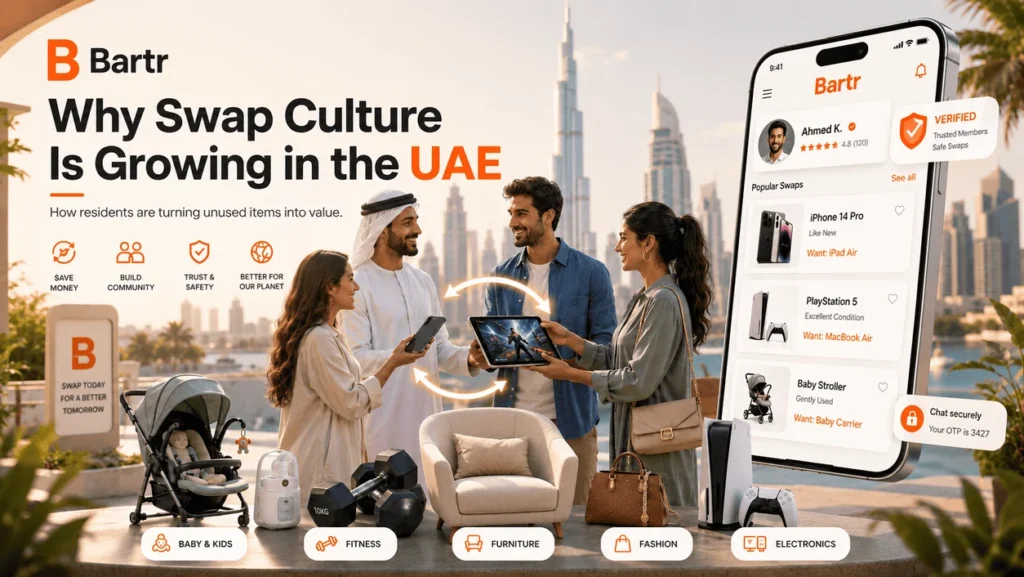
Something has shifted in how UAE residents deal with the things they no longer use.
For years the default was simple: sell it, or throw it out. Now a third option is becoming normal. People are trading items directly with each other instead of turning everything into cash first.
This is not a fashion. It is a practical answer to how life actually works here.
Very few countries churn households the way the UAE does. Every year, large numbers of people arrive needing to furnish an empty home, and large numbers leave needing to empty one.
That creates a constant, predictable cycle:
One person’s problem is the other person’s shopping list. Swapping simply connects the two.
The cycle peaks in the same months every year. Departures cluster in the summer; arrivals cluster around the start of the school year. Supply and demand hand off almost perfectly between July and September.
It is not one type of person. Four groups drive most of the activity, and each has a different reason.
The largest group by far. Arrivals need to furnish a home quickly without paying retail prices for things they may only use for a couple of years. Leavers need everything gone before a handover inspection. Both are working to a deadline, which makes them motivated and reliable to deal with.
Children outgrow clothes, bikes, car seats and toys on a schedule nobody can slow down. A pushchair used for eighteen months is not worn out — it is simply finished with. Parents tend to be the most repeat-active swappers because the cycle never stops.
Phones, laptops, tablets and consoles turn over faster than almost anything else. Most households have at least one working device sitting unused in a drawer, waiting for a decision nobody makes.
Gym equipment, cameras, musical instruments, board games and craft supplies are bought with enthusiasm and often used less than planned. These items hold real value to the right person and almost none to a general buyer, which is exactly the gap swapping fills.
Ask anyone who has tried to sell a sofa before a move. The item is rarely the problem — the process is.
Selling asks you to do several jobs at once: value the item, defend that value, answer repetitive messages, and hope the buyer turns up. Many people give up and give the item away, or bin it.
Swapping removes the argument entirely. You are not defending a price. You are asking a much simpler question: do these two items match?
Most people reach for “sell” by habit, then quietly downgrade to “donate” or “bin” when selling turns into work. Swapping sits in the gap those two leave behind.
Item for item. No money moves at all. This is the cleanest trade and the most common one.
Values rarely match exactly. A two-year-old phone and a newer tablet are close, not equal. Swap plus cash lets both people agree a small, fair difference and settle it in person at the handover. See how swap plus cash works.
Sometimes you just want the item to go to someone who needs it. Donating is the fastest route when speed matters more than return.
These are the everyday trades that make up most activity:
None of these needed a bank transfer, a price argument, or a shop.
A market like this only functions if people can trust strangers enough to meet them. Three things carry most of that weight.
Honest descriptions. The single biggest cause of a failed swap is an item that does not match its listing. Disclosing a scratch, a missing charger or a repair costs you nothing and saves both people a wasted trip.
Meeting in person. Every Bartr exchange happens face to face, in a public place, so both sides inspect before anything changes hands. Nobody posts an item to a stranger and hopes. That single rule removes most of the risk that online selling carries.
Reputation. Ratings and reviews mean reliable people become easy to spot and unreliable ones do not last. If you are new, being specific, punctual and honest builds a usable reputation within a handful of swaps. See how ratings and reviews build trust.
The UAE also publishes clear guidance on consumer rights and safe online dealing, which is worth knowing before any exchange with someone you have not met — see consumer protection on the official government portal.
Every swapped item is one less thing manufactured and one less thing thrown away. That matters more in a market where household turnover is this high.
The UAE treats waste as a resource to be managed rather than simply removed, and sets out formal guidance on how household and electronic waste should be handled — you can read the national approach to waste management on the official UAE Government portal, and the wider environmental strategy from the Ministry of Climate Change and Environment.
Reuse sits above recycling in that order of preference. A working item that changes hands stays useful. A recycled one has already lost most of its value. More on this in why swapping is a sustainable habit.
You do not need to care about market trends to benefit from one. The practical takeaway is simple: before you sell or bin something usable, check what it could become.
Use this quick check:
Four yes answers means swapping will almost certainly beat selling it cheaply or throwing it away.
Start with one item. Photograph it properly, describe it honestly, and say what you are looking for. Our guides on valuing your item for a fair swap and photographing items well cover the two things that make the biggest difference.
Bartr is live across all seven Emirates — Dubai, Abu Dhabi, Sharjah, Ajman, Ras Al Khaimah, Fujairah and Umm Al Quwain — and matching is local by default, so most swaps happen close to home.
It is a platform where people exchange items directly instead of selling them. You list what you no longer need, browse what others are offering nearby, and agree a trade. Money is optional rather than central.
Because household turnover is unusually high. People arrive, move and leave constantly, which creates a steady supply of good items and a steady demand for them. Swapping connects the two without anyone having to price and defend an item.
It depends what you want. Selling is right if you genuinely need cash. Swapping is better when you need an actual item, want to avoid haggling, and would rather not pay fees. Many people do both.
No. The app is free to download, listing items is free, and there is no commission on any exchange.
Phones and electronics, furniture, home appliances, fashion, baby and kids gear, sports equipment, books, collectibles, home décor and pet supplies. Anything unsafe, recalled, counterfeit or prohibited should not be listed.
All seven: Dubai, Abu Dhabi, Sharjah, Ajman, Ras Al Khaimah, Fujairah and Umm Al Quwain.
Stop buying. Start swapping. List one item you no longer use on Bartr today and see what it could become — free, local, and across all 7 Emirates.