Market Insights
How to value your item for a fair swap
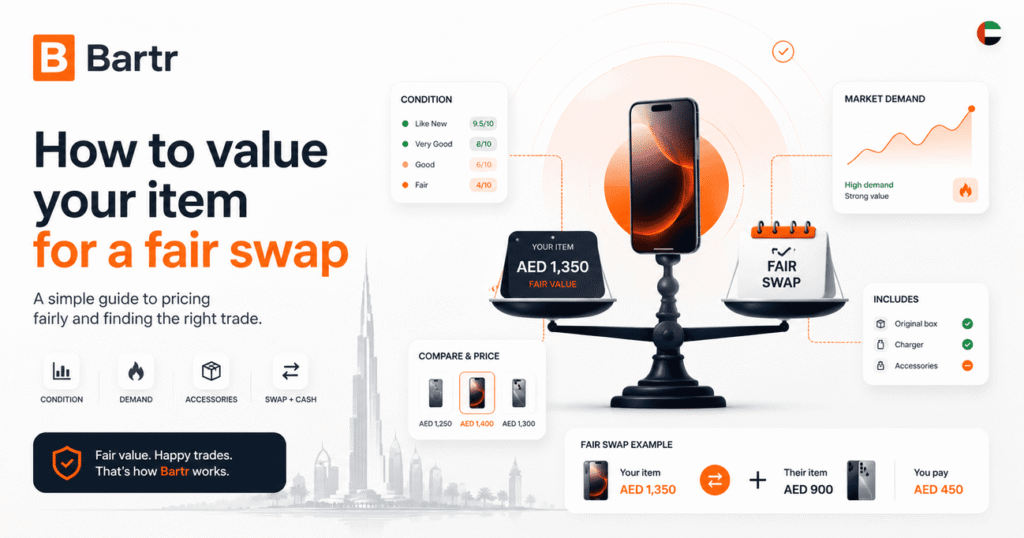
When you sell, the number is the whole negotiation. You set a price, and every message that follows is a test of it.
A swap works differently. You are not defending a figure — you are answering a simpler question: are these two items a fair match? The goal is not to maximise what you extract. It is to reach an exchange both people feel good about, quickly.
That changes how you should think about value. You still need a realistic number, but it is a reference point for a conversation, not a wall to defend.
What you paid two years ago tells you almost nothing. This is the single most common mistake new swappers make, and it is the reason most stalled listings stall.
Instead, spend ten minutes doing this:
Asking prices skew high because anyone can ask for anything. A listing that has sat untouched for a month is evidence of the wrong price, not the right one.
Some items have no obvious local comparison — a niche instrument, an unusual piece of furniture, an older hobby item. In that case, work from the nearest equivalent and be upfront that the value is approximate. Saying “I think this is worth roughly X, happy to hear what you think” is far more effective than inventing false precision.
Two identical phones can be worth very different amounts. Condition and completeness usually move the number more than age does.
These bands are a rule of thumb to argue with, not a formula. Treat them as a starting point and adjust for what your own local market is doing.
Be honest with yourself here. The other person will inspect the item in person. Overvaluing out of attachment — you paid a lot for it, you looked after it — leads to failed swaps and wasted trips. A realistic valuation leads to faster matches.
It is rare for two items to land on exactly the same number. That is not a problem to solve, it is a normal part of trading.
A swap where one item is worth around AED 800 and the other around AED 600 is still a good swap. The difference can be settled as a cash top-up at the handover — the swap plus cash model, and the most common way real trades close.
One rule matters more than any other here:
Agree the top-up in the chat, before anyone travels. Renegotiating at the exchange point is uncomfortable, and it is where most swaps collapse. If the numbers are confirmed in writing beforehand, the meetup becomes a formality: inspect, confirm, exchange, done.
Full detail in our guide to how swap plus cash works.
Market value is a reference point, not a rule. There is a second number that matters just as much: how useful the item is to you, right now.
If you genuinely need what is being offered, and the trade gets you it this week, the exact market comparison matters less than the utility you gain. A swap where you trade an AED 700 item for an AED 500 item you will actually use is better than holding out three months for a perfect match that never appears.
Swapping is not financial trading. There is no margin to protect. When both people walk away with something more useful to them than what they started with, the swap worked — regardless of what a price calculator says.
The phone. A three-year-old handset, excellent condition, box and charger included. Comparable local listings sit around AED 900. Excellent condition puts it near AED 750. Someone offers a tablet worth roughly AED 850. You agree they add nothing and you add AED 100 — confirmed in the chat two days before the meetup.
The desk. A two-year-old desk, good condition, one scuff on the top edge disclosed in the listing. Local comparisons sit around AED 400, so you call it AED 280. You want a bookshelf, and someone offers one worth about the same. No cash changes hands at all. One meeting, both problems solved.
One factor sits outside condition entirely: when you list. The UAE runs on a predictable calendar, with departures clustered through the summer and arrivals around the start of the school year.
An identical desk listed in a busy month and a quiet one is worth the same on paper but behaves very differently in practice — more offers, faster, and less pressure to drop your expectations after two silent weeks. Timing costs nothing and often moves the outcome more than shaving your number does.
That is enough to enter any swap conversation with confidence. Pair it with our guides on photographing items well, preparing an item before handover and getting the most from your first swap. It is also worth knowing your rights as a consumer in the UAE — the government portal covers consumer protection in plain terms.
Compare it against similar items in similar condition listed locally right now, weighted towards ones that actually sold. Then adjust down honestly for wear, missing accessories and how hard it is to transport.
No. The original price is the most misleading number available. Second-hand value is set by current local supply and demand, not by what you spent.
Use swap plus cash. Agree the difference in the chat before the meetup so both people arrive knowing exactly what will happen. Never renegotiate at the handover.
Often yes, provided you disclose the fault clearly and price it accordingly. Plenty of people are happy to take on a known, described issue — what ends trades is discovering it in person.
Work from the nearest equivalent, say openly that the value is approximate, and invite the other person to counter. Honest uncertainty reads far better than invented precision.
No. Listing and swapping are free, there is no commission, and Bartr does not hold payments — any cash difference is settled directly between the two people at the handover.
Price it as it is today, describe it honestly, and list it free on Bartr — a realistic listing finds its match far faster than an optimistic one.