Market Insights
Why swapping is one of the most sustainable habits you can build
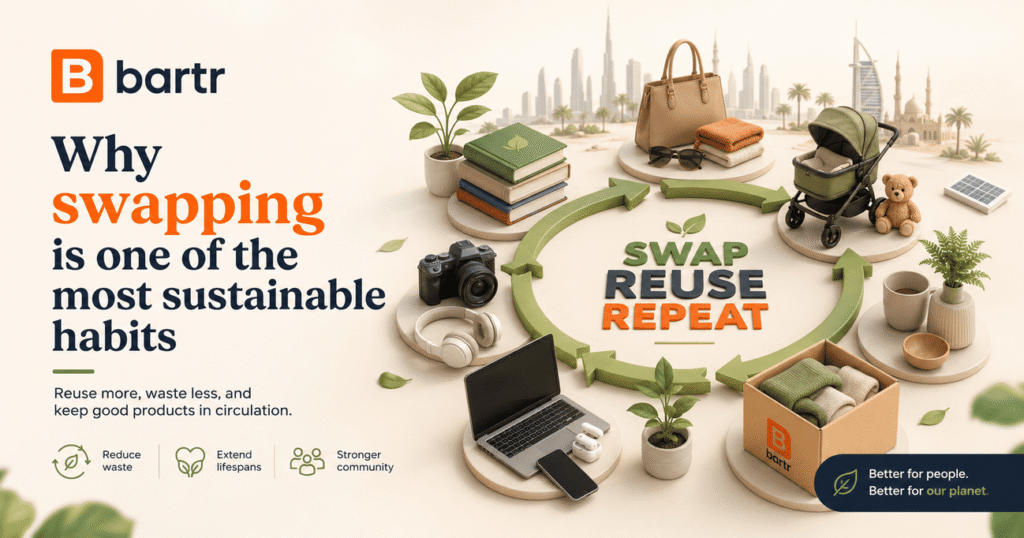
Open any bin room in a UAE apartment tower at the end of the month and the pattern is obvious. Bookshelves. Office chairs. Kettles. Children’s bikes. Almost none of it is broken.
The item did not fail. The relationship between the item and its owner ended. A phone replaced after two years still works perfectly. A pram outgrown in twelve months is structurally sound. A treadmill that lost its novelty functions exactly as designed.
That distinction matters, because it is the entire environmental argument in one line: if the thing still works, throwing it away wastes everything that went into making it.
Recycling has an unusually good reputation. It is genuinely useful — but it is a long way down the list of preferable outcomes, not the top of it.
The reason is simple. Recycling recovers materials. It does not recover the design, the assembly, the components or the transport. A recycled desk becomes wood chips and screws. A reused desk stays a desk.
This ordering is not an opinion — it is how waste policy is structured. The UAE sets out its national approach on the official waste management portal, and the wider environmental strategy sits with the Ministry of Climate Change and Environment.
For two of the biggest swap categories — electronics and clothing — the environmental cost is heavily concentrated in production rather than use.
A smartphone’s manufacturing stage involves mining, refining, component fabrication and global shipping, and for a typical device that stage dominates its lifetime footprint. Charging it for a few years is a small fraction by comparison. The same logic applies to clothing: growing, dyeing, weaving and transporting a garment costs far more than washing it.
The practical consequence is counter-intuitive but important:
Keeping an existing item in use is almost always better than replacing it with a more efficient new one. The new item starts with a debt that takes years of efficiency gains to repay — if it ever does.
So when a phone moves from one owner to another instead of being replaced by two new devices, the saving is not marginal. It is the entire manufacturing footprint of a phone that never had to be made.
You do not need a carbon calculator. Count owners instead:
The object does not change. Only the number of people who benefit from its existence does.
Household turnover here is unusually high. Every year large numbers of people arrive needing to furnish an empty home, and large numbers leave needing to empty one. Lease renewals move families between apartments in between.
Each of those events forces a decision about dozens of items at once — usually under time pressure, often the week before a handover inspection. Under that pressure, the fast option wins, and the fast option is normally the bin.
That is precisely where swapping helps most. It gives the person clearing out a route that is nearly as fast as discarding, and gives the person arriving something they were about to buy new. The peak runs July to September, when departures and arrivals hand off to each other. More on that cycle in why swapping is on the rise in the UAE.
E-waste is the fastest-growing waste stream in most countries, and it is the one where a working item retains the most value to someone else.
Two rules cover almost everything:
Never pass on a swollen battery or a damaged charger as if it were fine — that is transferring a hazard, not extending a life. Our guide to e-waste in the UAE and swapping electronics covers both routes, and the used electronics swap checklist covers the handover itself.
Wardrobes turn over faster than almost anything, and clothes are rarely worn out when they are replaced. Sizes change, seasons change, and taste changes.
The good news is that clothing is one of the easiest things to pass on: light, cheap to transport, and easy to assess visually. Wash and fully dry items first, disclose fading, bobbling, broken zips and repairs, and be honest about real fit rather than the label. See how to swap clothes and fashion in the UAE.
None of this requires a lifestyle change. It looks like:
Each one is a small decision made at a moment when the alternative was a bin bag.
The standard objection is fair: individual choices are small, and systemic change is what counts.
Both things are true at once. One swapped bookshelf does not move a national statistic. But habits are how norms shift, and norms are what make systemic change politically and commercially possible. Reuse only became normal in the countries where it is normal because enough people did it that it stopped feeling unusual.
There is also a more honest argument. You do not have to sacrifice anything. Most sustainable habits ask you to pay more, wait longer or give something up. Swapping asks none of those — you end up with an item you needed, at no cost, having saved yourself a shopping trip. The environmental benefit is real, and it happens to be free.
Make it a default rather than a project:
Two habits do most of the work: pausing before you discard, and checking before you buy.
Yes, when the item still works. Recycling recovers materials but loses the design, assembly and components. Reuse keeps the entire item in service, which is why waste policy places it above recycling.
One swap avoids one new item being manufactured and one working item being discarded. Individually that is small; the point is the habit and the norm, not any single trade.
Route them properly rather than passing on a problem. Damaged electricals, swollen batteries and hazardous items belong in designated waste streams, not a general bin and not a swap.
Almost always for items that still work well, because the manufacturing footprint is already spent. The main exception is something so inefficient or unsafe that keeping it running causes more harm than replacing it.
No. Downloading the app, listing items and completing a swap are all free, with no commission on any exchange.
Electronics, furniture, appliances, fashion, baby and kids’ gear, sports equipment, books, home décor and pet supplies. Anything unsafe, recalled, counterfeit or prohibited should not be listed.
Your unused items deserve a second life. Pick one thing you have finished with, list it free on Bartr, and let it keep working for someone else.