Market Insights
Swapping vs selling: why trading wins for most people in the UAE
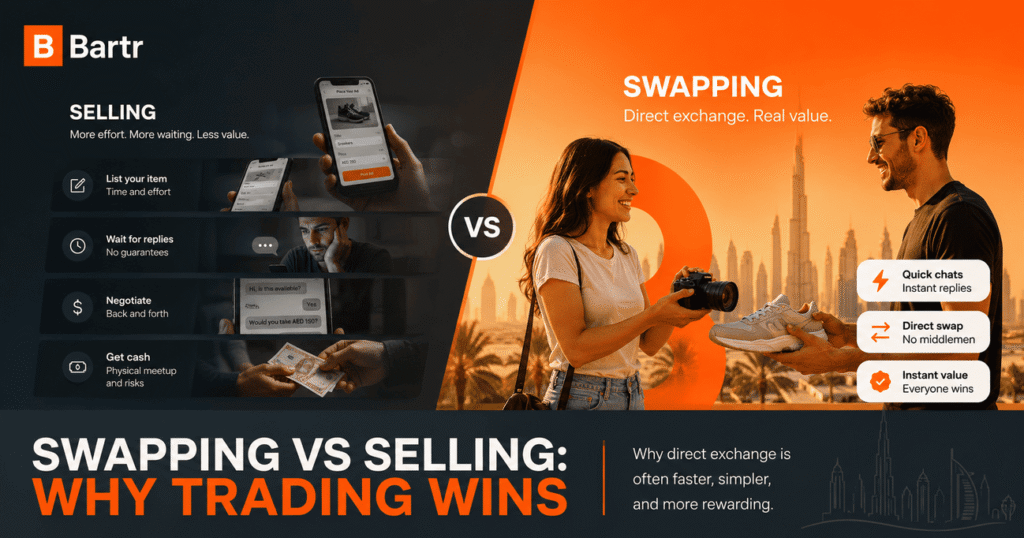
You have decided to get rid of something. A desk, a phone, a bike. The next thought is almost automatic: how much can I get for it?
It is worth pausing there, because the honest answer for most people is not “money”. It is something else they need. The cash was never the goal — it was the middle step between an item they had finished with and an item they wanted.
Swapping simply deletes that middle step.
Neither column is better in the abstract. They answer different questions, and the right one depends entirely on what you are short of.
Ask anyone who has tried to clear a flat before a move. The item is rarely the problem. The process is.
The moment you write a price, you have made a claim — and every reply is a test of it. “Best price?” arrives before anyone has looked at the photos. You either hold firm and wait, or drop the price and wonder why you bothered.
In a swap there is no number to defend. Both people are looking at two items and asking a much simpler question: is this a fair match? That question has an obvious answer far more often than “is this worth AED 400?” does.
Photographing, listing, answering the same three questions ten times, arranging a meetup, then being stood up. All of that happens before you see a dirham. It is why so many sales quietly become donations or bin bags — not because the item had no value, but because the process outlasted the seller’s patience.
Even a successful sale leaves you halfway. You have money and still no desk. The second half — researching, comparing, buying — is its own project. A swap finishes both halves in one meeting.
This is not a universal argument. It is much stronger here than in most places, for one specific reason: household turnover.
Every year, large numbers of people arrive needing to furnish an empty home, and large numbers leave needing to empty one. In between, lease renewals move families between apartments where the old furniture no longer fits.
The result is a steady, overlapping supply of good items and real demand for them, concentrated in the same cities and often the same neighbourhoods. Matches are easier to find here than the idea of swapping might suggest — and the peak runs from July to September, when departures and arrivals hand off to each other. More on that pattern in why swapping is on the rise in the UAE.
You have a desk you no longer need, and you want a bookshelf.
The selling route. List the desk. Field five messages, three of which open with “last price”. Agree AED 250 with someone who then cancels. Relist. Eventually sell for AED 200. Now start again as a buyer: search for a bookshelf, compare a few, negotiate, arrange a second meetup, pay AED 220. Two listings, two meetups, roughly three weeks, and you are AED 20 down.
The swapping route. List the desk and say you are looking for a bookshelf. Someone in the next building has the opposite problem. You agree, meet once, and both walk away with what you wanted. One listing, one meetup, no money at all.
The second route is not always available — but when it is, the difference is not small.
Swapping is not the answer to everything, and it is worth being honest about that.
Our guide to bartering vs selling, item by item walks through how this plays out for furniture, phones and other common categories.
They often will not, and that is not a dead end. Swap plus cash lets both people agree a small difference and settle it in person at the handover — keeping the simplicity of a trade without pretending two items are identical in value. See how swap plus cash works.
There is a second argument, and it is not sentimental. Every item that changes hands directly is one less thing manufactured and one less thing thrown away.
That matters more in a market with turnover this high. The UAE treats waste as a resource to be managed rather than simply removed — its national approach is set out in the official waste management guidance, with the wider strategy from the Ministry of Climate Change and Environment. Reuse sits above recycling in that order of preference, because a working item that changes hands keeps all of its value, while a recycled one has already lost most of it.
Run through these before you list anything:
Mostly yes? Swap it. A clear “I need the money”? Sell it. There is no wrong answer — only a wrong assumption, which is reaching for “sell” automatically without asking what you actually want back.
The things that make a trade succeed are unglamorous and entirely within your control: real photos in daylight, an honest description including the flaws, a specific first message, and a public meetup where both people inspect before anything changes hands. Never pay in advance, and never share an OTP or password — the UAE’s consumer protection guidance is worth knowing before dealing with anyone you have not met.
Start with our guide to getting the most from your first swap and the safe swap meetup checklist.
Compared with a single sale, sometimes. Compared with the full journey — sell, wait, buy — it is usually faster, because you are running one process instead of two. The comparison people make in their head is rarely the one that matches what they actually end up doing.
You are not looking for one. You are looking for two people whose unwanted items happen to solve each other’s problem, and swap plus cash absorbs the rest. Being flexible about the category — a bookshelf, or anything that stores books — multiplies your options immediately.
Both routes carry the same real risk, which is meeting a stranger. The protection is identical either way: a public place, an inspection before handover, nothing paid in advance, and no codes shared.
For most everyday items, yes — because most people want a replacement item rather than cash, and swapping gets there in one step instead of two. Selling is the better choice when you genuinely need money or there is nothing you want in return.
Usually the opposite. Selling means accepting a discounted price, then paying near-retail for the replacement. A swap skips both discounts, and there are no fees or commission on Bartr.
Say clearly in your listing what you are looking for, and keep it open rather than naming one exact model. Matches also appear in waves, so an item that finds nothing in a quiet week may attract several offers when the moving season starts.
Yes. Swap plus cash covers the gap when two items are close but not equal. Both people agree the difference and settle it in person at the handover.
No. Downloading the app, listing items and completing a swap are all free, with no commission on any exchange.
Across all seven Emirates — Dubai, Abu Dhabi, Sharjah, Ajman, Ras Al Khaimah, Fujairah and Umm Al Quwain. Matching is local by default, so most swaps happen close to home.
Before you price something up, ask what you actually want back. List one item free on Bartr and see what it could become.