Barter Guides
Bartering vs Selling: How to Sell Old Furniture, Phones & More — Which Is Better for You?
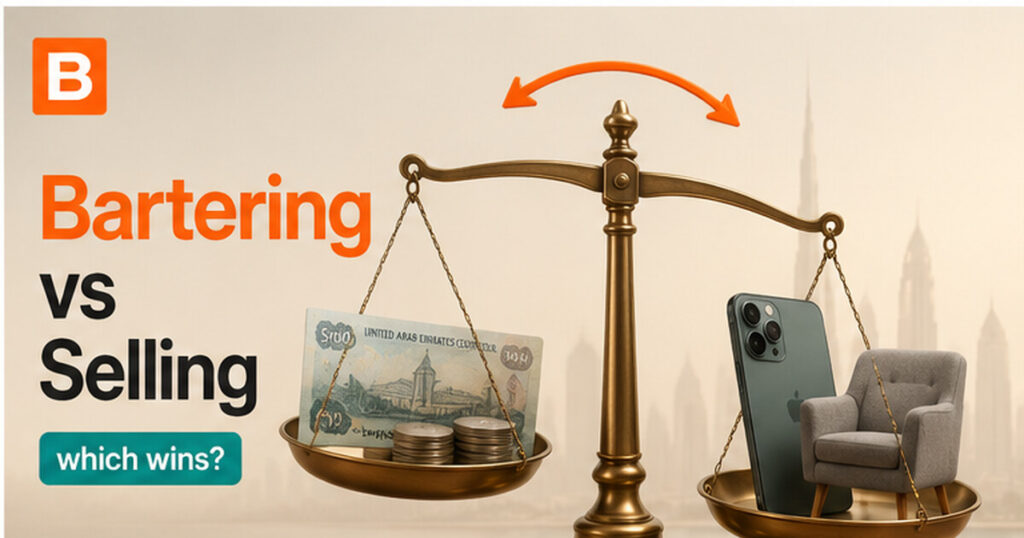
A sofa that no longer fits the new apartment. A phone you have upgraded from. Jewellery you never wear. The instinct is to search “how to sell old furniture” or “sell old phone” and start there.
That instinct is right about half the time. This guide goes item by item through what UAE residents most often want to get rid of, and says plainly which route suits each one.
If you want the underlying reasoning rather than the item-by-item answer, our companion piece on swapping vs selling covers the decision itself.
Selling exchanges an item for money. You list it, agree a price, and receive cash or a transfer once a buyer commits.
Bartering exchanges an item directly for another item. No money needs to move at all — though a cash difference can settle a gap when the two are not quite equal.
Usually swap. This is the clearest case of all. Selling furniture comes with real friction: the items are bulky, buyers expect delivery included, and prices get negotiated down hard from whatever you asked. Plenty of sofas end up beside the bins the week before a handover inspection simply because the seller ran out of time.
Swapping removes the pricing argument, and because almost every household eventually needs to replace something, matches happen faster than people expect. Sell instead if the piece is genuinely high-end or designer with real resale demand, or if you need moving costs covered in cash.
Whichever route you pick, measure the item, the destination and the route — doorways, corridor turns and the service lift. See swapping furniture in the UAE.
Swap unless it is a current flagship. Recent top-end models hold strong cash value and sell quickly. Everything else — a two or three-generation-old handset, a working laptop, a tablet — is usually worth more as a trade than as a discounted sale, because the person receiving it is comparing against buying new rather than against a wholesale price.
A shop trade-in is the third option, and it gives you store credit rather than money or an item. Our comparison of phone trade-in vs swapping covers when each wins.
Whatever you choose: back up, sign out of every account, disable activation lock, remove SIM and memory cards, then factory reset. The used electronics swap checklist has the full sequence, and the UAE publishes data protection guidance worth reading first.
Usually sell, sometimes swap. Gold has a transparent, weight-and-purity based market, so a jeweller will give you a fair and immediate cash figure. If you need money, that is hard to beat.
Swapping makes sense when you would rather have a different piece, or something else entirely, than the melt value of something you never wear. Be precise about weight, purity and hallmarks, and expect the other person to want it verified.
Sell. Vehicles involve registration, insurance and transfer procedures that a casual item-for-item trade is not designed for. Bartr is not the right route here.
Swap. Individually low value, so selling rarely justifies the effort of listing, messaging and meeting. As a trade they work beautifully — condition is visible, there is nothing to test, and they are easy to carry. Sell instead for rare editions or in-demand current textbooks, where the cash figure is genuinely meaningful.
Swap. Most clothing is replaced because sizes, seasons or taste changed, not because it wore out — and second-hand cash prices for everyday items are low enough that selling rarely repays the effort. Wash and dry items first, share real measurements, and disclose fading, bobbling and repairs. See how to swap clothes and fashion in the UAE.
Swap. The fastest-moving category there is, because the cycle never stops: what your family has outgrown is exactly what a family one stage behind needs. Apply a higher standard to safety-critical items such as car seats and helmets, where an unverifiable history is a genuine risk — see swapping baby and kids’ items safely.
Depends entirely on rarity. Genuinely rare pieces belong with a specialist buyer who can authenticate and price them. Common items are better swapped with someone who collects, and who will value them far above what a general buyer would pay.
Selling looks like the higher-value option because it produces a number. Three things quietly eat that number:
Add those together and a swap that looked like a slight loss on paper often comes out ahead in practice.
It is worth being honest about the limits:
And where two items are close but not equal, you do not have to choose between the two routes at all. Swap plus cash lets both people agree a small difference and settle it in person — see how swap plus cash works.
There is a third option that often gets forgotten, and for some items it is the right one. If a piece has little cash value, no obvious trade partner, and is simply taking up space you need back this week, donating it finishes the job in a single step.
Speed is the trade-off you are buying. You get nothing back, but you also skip pricing, messaging, negotiation and waiting for a match — which for a low-value item is frequently a better deal than it sounds. Bartr supports donating alongside swapping for exactly this reason.
Lean towards convenience and usefulness, and bartering is the better route. A clear “I need the money” and strong resale demand, and selling still wins.
Either way, the same safety rules apply: meet in a public place, inspect before exchanging, never pay in advance and never share a code. The UAE government portal sets out your consumer protection rights, and our safe swap meetup checklist covers the handover.
Barter, for most pieces. Furniture is bulky, hard to price and expensive to move, which is exactly what puts buyers off — while for a swap it simply means agreeing transport in advance. Sell if the piece is high-end with proven resale demand.
Sell a current flagship in good condition. Swap anything older but working — you will usually get more back as an item than as a discounted cash sale.
Only if you want a different item rather than cash. Gold has a transparent weight-and-purity market, so selling is straightforward when money is the goal.
Not practically. Vehicles involve registration and transfer procedures that item-for-item trading is not designed for.
No, and most people do not. Sell the items you want cash for, and swap the ones where you actually need a replacement.
No. Listing and swapping are free with no commission, and Bartr does not hold payments — any cash difference is settled directly between the two people.
Before you list something for sale, check what it could become instead. List one item free on Bartr and see what people near you are offering.