Lifestyle Guides
Clothes Donation in Dubai: Where to Donate Clothes, Toys and Books
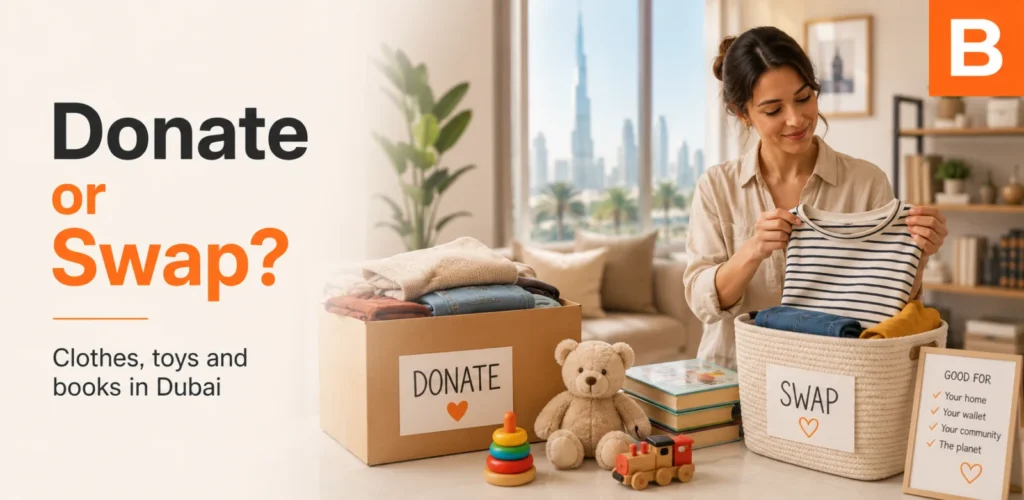
Donating and swapping both keep usable things in circulation and out of landfill. They are not in competition — they answer different questions.
Donating is the fastest route when you want something gone, you want nothing back, and the item is genuinely usable. One trip, no messages, no arranging.
Swapping keeps the value with you when the item is worth enough that a return matters, and there is something you actually need.
Most clear-outs need both. The practical rule: donate when speed matters more than return; swap when the return is worth the few extra days.
Across the UAE, clothing and household donation points appear in shopping malls, community centres and residential areas. Charitable organisations also run periodic collection drives, particularly around Ramadan, when both donations and demand peak.
Because locations, opening hours and accepted categories change, always check current details with the organisation directly before travelling with bags of items. A wasted trip with a car full of boxes is a frustrating way to spend a Saturday, and turning up unannounced at a collection point that has moved is common.
Some building management offices and community groups also coordinate collections, particularly during the summer departure season. That is often the easiest route if it exists where you live.
This is the part most worth taking seriously, because getting it wrong actively harms the organisation you were trying to help.
Donated items should be clean, dry, complete and genuinely usable. Wash clothing and let it dry fully. Wipe hard toys. Check that games have their pieces and books are intact.
Anything torn, stained, broken or missing essential parts is not a donation — it is waste that someone else now has to sort, handle and pay to dispose of. Charities absorb that cost from funds that were meant for their actual work.
The honest test before each bag: would you give this to a friend? If not, it belongs in recycling or proper disposal, not a donation bin.
Larger items are the main gap. Furniture and appliances are accepted far less often than people expect, because storage space and transport are the real constraint for most organisations — not willingness. Always ask before assuming, and see how to dispose of old furniture in Dubai for the alternatives.
Safety-critical children’s products such as car seats and helmets are commonly declined, and for good reason: impact damage and storage conditions cannot be verified, and the item may look perfect while offering far less protection. See swapping baby and kids’ items safely.
Twenty minutes of preparation makes a genuine difference at the receiving end:
Sorted, labelled donations can go straight onto a shelf. Unsorted ones need volunteer hours before they help anyone.
Donations follow the same UAE calendar as everything else, and knowing it saves a wasted trip.
Collection drives and donation activity increase around Ramadan, when both giving and need are highest. Summer brings a second surge as households leave the country between July and September, which means collection points fill quickly and some temporarily stop accepting certain categories.
That has two practical implications. If you are donating during a peak, check capacity before you travel rather than after — a full collection point cannot take your bags however good they are. And if you are clearing a home before a move, start early enough that a “we cannot take these this week” answer is an inconvenience rather than a crisis.
Back-to-school is the third window worth knowing, when uniforms, books and school supplies are actively wanted rather than merely accepted.
Some things are worth more than a quick trip to a collection point, and it is worth pausing over them.
If an item still holds real value — a good coat, a working device, a complete set of children’s books, furniture in decent condition — and there is something you genuinely need, swapping puts that value to work rather than giving it away. It keeps the item in active use just as effectively.
The two are also not exclusive. A common pattern that works well:
That order captures the value first and clears everything else quickly. See the swap-first decluttering plan and junk removal vs swapping.
You are clearing three bags of clothes, a box of toys and two boxes of books.
You sort once. A winter coat, a barely-worn pair of boots and a complete set of early readers go onto Bartr — those are worth a return, and you need packing materials. The rest of the clothing is washed, dried, packed by size and labelled. The toys are wiped down and checked for missing pieces; two broken ones come out.
You message the organisation to confirm what they are currently accepting and where. Then one trip, boxes labelled, nothing they have to sort.
The two broken toys go to recycling. Total extra effort over just dumping everything: about half an hour.
Clothing carries most of its environmental cost in production — growing, dyeing, weaving and transporting a garment costs far more than wearing it. A garment that reaches a second owner effectively halves that cost per person.
Reuse sits above recycling in the order of preference for exactly this reason, and the UAE structures its waste approach the same way — see the official waste management portal and the wider strategy from the Ministry of Climate Change and Environment. More in why swapping is a sustainable habit and how to swap clothes and fashion in the UAE.
It helps to know roughly what your bags go through, because it explains why the condition rules exist.
Donated items are sorted, assessed, and then either distributed directly, sold to fund the organisation’s work, or — if unusable — disposed of at the charity’s own cost. Every stage takes volunteer or staff time.
Which is why sorted, clean, labelled donations are genuinely more valuable than the same items delivered loose. A box marked “boys 5–7, twelve pieces, washed” goes straight onto a shelf. An unsorted bag needs someone to open it, check it, wash what can be saved and bin the rest.
Ten minutes of sorting at your end can save an hour at theirs, which is the actual difference between a helpful donation and a well-intentioned one.
Clothes donation boxes are common in malls, supermarkets, schools and residential communities across Dubai. Read the label on the box for what it accepts, bag clean and dry items, and never leave bags beside a full box, where they are treated as rubbish.
Clothing and household donation points appear in malls, community centres and residential areas, and charitable organisations run periodic drives. Check current locations and accepted categories with the organisation before travelling.
No. Donations should be clean, dry, complete and usable. Unusable goods create sorting and disposal costs for charities — route damaged items to recycling instead.
Donate when speed matters and you want nothing back. Swap when the item holds real value and there is something you need yourself. Most clear-outs use both.
Usually not. Safety-critical items whose impact and storage history cannot be verified are commonly declined, and that is the right call.
Sometimes, but far less often than people assume — storage and transport are the constraint. Always ask first rather than arriving with a sofa.
Washed, dried, sorted by category, boxed and labelled on the outside, with small parts bagged to their main item. Sorted donations go straight onto a shelf.
Donating what you cannot use is generous. Swapping what still holds value is smart. List the second group on Bartr and put it to work.