Lifestyle Guides
Junk Removal vs Swapping: What Your Unwanted Items Are Really Worth
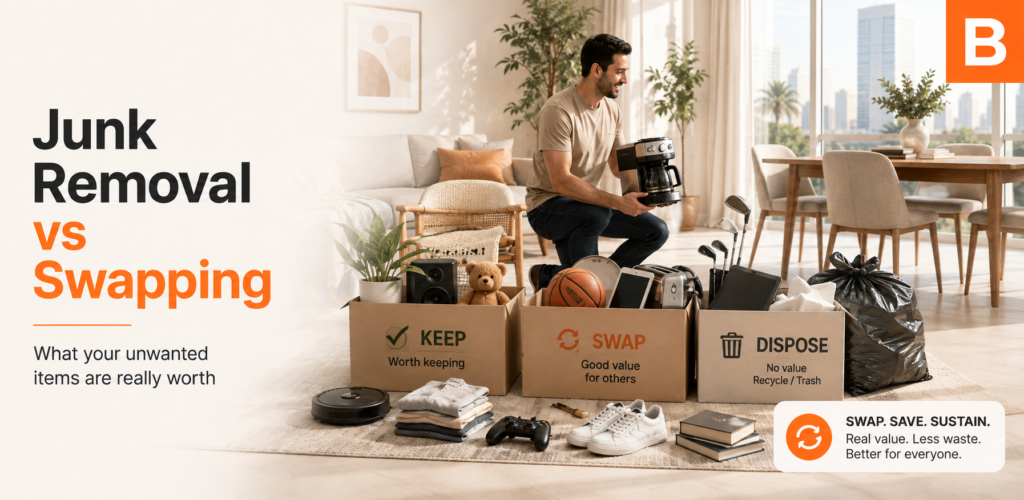
It solves a real problem. A flat needs clearing, often at short notice, and a collection service arrives, does the lifting, and leaves. No listings, no messages, no strangers, frequently no charge.
Before a move or an end of tenancy, that convenience is worth a great deal, and there is nothing wrong with using it. The issue is not the service — it is what you put on the truck.
Because everything is treated identically. A genuinely broken chair and a two-year-old sofa leave the building the same way, and only one of those was actually junk.
Twenty minutes, three piles. This is the entire method.
The “unsure” pile is the one to watch. If you let it exist permanently, everything drifts into it and then onto the truck by default — which is exactly how usable things get discarded. Give it a date, written down, and treat that date as real.
Most people are surprised by how much survives an honest sort. Furniture, electronics, kitchen equipment, sports gear, children’s items and books almost always retain real use even once you have stopped wanting them.
The test is simple and it takes two seconds per item:
Would you accept this if someone offered it to you, honestly described?
If yes, it is worth listing rather than discarding. If no, it is junk, and the collection service is doing you a favour.
That question cuts through the thing that actually drives most disposal decisions, which is not the item’s condition but your own tiredness at the end of a move.
Many collection services take household items at no charge because they resell or recycle what they collect. That is a perfectly legitimate business model, and it is worth understanding what it means for you.
The cost is not cash. It is the value of everything usable that leaves the building, transferred to someone else at the point where you were too busy to think about it.
A swap converts that same value directly into something you need — and unlike selling, there is no pricing, negotiation or waiting for a payment. Which matters, because pricing and negotiation are precisely the friction that makes people reach for the truck in the first place. See swapping vs selling.
Some things should not be passed on to another person, and being clear about that is what makes the rest of this credible.
For these, a proper disposal or recycling route is the responsible answer, not a swap. Electronic waste in particular should go through an authorised e-waste channel rather than general or bulky waste, where batteries can leak or ignite — see e-waste in the UAE.
The UAE treats waste as a resource to be managed rather than simply removed; the national approach is set out on the official waste management portal, and for bulky items in Dubai the current service conditions are on the Dubai Municipality website.
The obstacle is rarely the items. It is that clearing a home is one long sequence of small decisions, made at the end of an already exhausting week, and every one of them takes energy.
Booking a collection service is appealing precisely because it converts several hundred decisions into one. That is a real benefit and worth acknowledging honestly.
The sort works because it does the same thing more cheaply. You are not deciding what to do with each object — you are answering one question about each, in two seconds, and putting it in a pile. The decisions come later, in batches, when you are dealing with a category rather than a cupboard.
Do it in one sitting rather than spread across the week. Momentum is most of the trick, and a half-finished sort is worse than none because everything ends up in the “unsure” heap by default.
This works because it puts the slow things first and the fast thing last.
First pass — one to two weeks before you need the space. List the larger and more desirable items: furniture, appliances, electronics, fitness equipment. These take the longest to arrange because of measurements, transport and building access. Put a clear final collection date in each listing.
Second pass — the final few days. Bundle the remaining small items into themed groups, offer anything suitable for donation, and only then book a collection service for whatever is genuinely finished.
Booking the truck last is the whole point. Booked first, it becomes the deadline everything else is measured against, and the sorting never happens.
The usual objection to swapping during a move is that someone will not turn up and you will be left with the item. Fair — and manageable:
See handling no-shows and ghosting for the messages that make this easy.
You are leaving a flat in three weeks and your first instinct is to book a clearance for the final Saturday.
Instead you spend twenty minutes sorting. The genuinely finished pile turns out to be a broken lamp, a cracked storage box and a dead printer. Everything else — a sofa, a desk, a microwave, two bags of books, a bike — passes the “would I accept this?” test.
You list the sofa, desk and microwave in week one with dimensions and a stated final date. The bike and books go up in week two as separate listings. By the final week, four have gone and you have picked up two suitcases and a set of packing materials you needed anyway.
Then you book the collection for the lamp, the box and the printer — and the printer goes to e-waste rather than on the truck.
If it works and you have a few days, swap it. If it works and you have hours, donate or give it away. If it does not work, recycle it or use the authorised disposal route for your emirate.
See also the swap-first decluttering plan for the full moving timeline, how to dispose of old furniture in Dubai for the seven routes compared, and why swapping is a sustainable habit for why reuse sits above recycling.
It varies. Many services take items at no charge because they resell or recycle what they collect. The cost to you is not cash — it is the value of anything usable that leaves with them.
Items with structural damage, exposed wiring, swollen batteries, active pest signs, serious mould or broken safety glass. Those need repair, recycling or authorised disposal.
One to two weeks before packing for bulky and higher-value items, with smaller items and bundles following. Book any collection service last, not first.
Swap or pass on anything that still works. Route genuinely broken devices through an authorised e-waste channel rather than general or bulky waste.
List the three or four largest items and let the rest go to collection. Even a partial sort captures most of the value, because the value is concentrated in the big things.
No. Listing, swapping and donating are all free, with no commission on any exchange.
Before you book a collection, check what is actually worth keeping in circulation. List the usable items on Bartr and let them find a new home.