Community Guides
No-Shows, Ghosting and Last-Minute Changes: How to Rescue a Swap
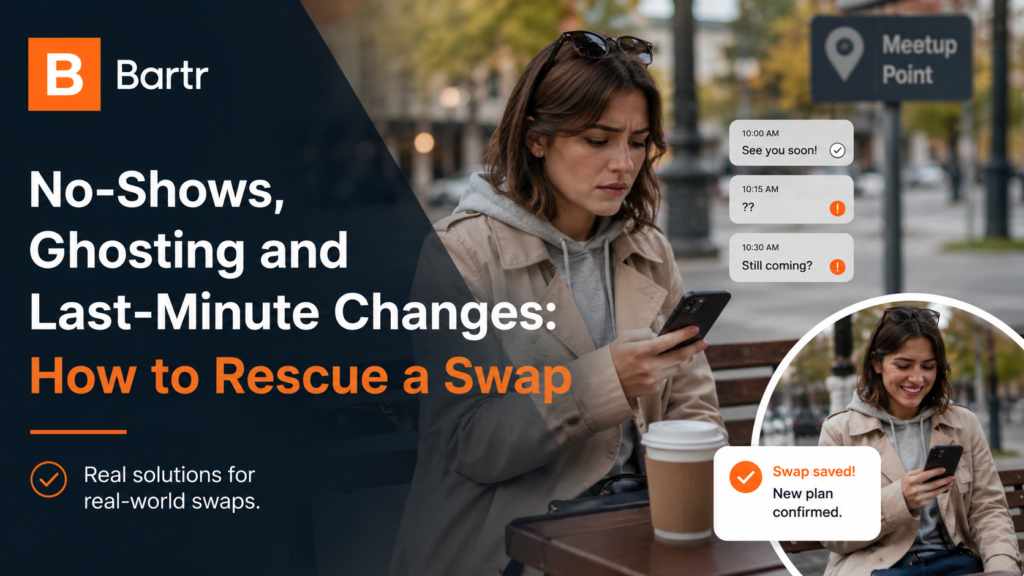
Traffic, work emergencies and family situations are real. A short delay with clear communication is a completely different thing from someone disappearing.
The useful test is not whether they are late. It is what they do next. Do they message you, apologise and offer a specific alternative? Or do they go quiet and resurface a week later wanting the same favour?
Judge the pattern, not the incident. One late arrival with a warning is nothing. Three vague cancellations is information.
This one habit prevents most wasted trips.
Step one, the day before. Send the actual details, not just “are we still on?” — a real confirmation makes mistakes visible:
“Confirming the coffee machine for the bookshelf, including the filter holder, at 6:30 pm outside the main entrance of [location].”
If they thought a different accessory was included, that message catches it a day early rather than at the handover.
Step two, before you leave. A short message saying you are setting off. For a longer journey, do not travel until they confirm they are also on their way.
No reply to step two means no journey. That is not being difficult; it is the whole point of the system.
Decide in advance how long you can reasonably wait, and communicate it calmly rather than standing there indefinitely getting annoyed.
Send one clear message with a deadline attached:
“I have arrived at [location]. I can wait until [time]. Please confirm your estimated arrival.”
If there is no reply by then, leave. And whatever the explanation offered, do not move to a quieter or more isolated location because it would be faster for them. That is a boundary worth holding regardless of how the day is going — see our safe swap meetup checklist.
Ask for one specific alternative: a day, a time and a place. “Maybe next week” is not a plan, and accepting it as one is how a single cancellation turns into three.
Keep your listing active until the new meetup is firmly confirmed. This matters more than people realise — taking a listing down on a promise costs you exactly the backup interest you are about to need.
One reasonable reschedule is generous. After repeated cancellations, stop investing time.
You do not need to argue, explain at length or work out why the person behaves this way. A single sentence closes it:
“I will make the item available to other users now.”
No accusation, no diagnosis, no argument to be had. That is deliberately what makes it work.
If accessories have disappeared, the condition has changed, or a different item is now being offered, ask for updated photos before travelling.
You can decline without penalty and without justification. And be alert to the specific trap here: accepting a worse substitute to recover the time you have already spent arranging the swap. That time is gone either way — the only question left is whether you also want the wrong item.
If it changes once you have arrived, the same applies. A cancelled meetup costs one trip; a bad swap costs the item.
Furniture pickups, booked movers and long journeys need stronger commitment than a coffee-shop handover.
That last point is worth repeating: advance payment to a stranger is a scam pattern, not a booking. See 10 swap scam red flags.
There is a quiet cost to being accommodating, and it is worth naming.
Every day you hold an item for someone who has not confirmed is a day it is invisible to everyone else. Interest in a listing peaks early and decays quickly — so a week spent waiting on one unreliable person often means restarting from scratch rather than picking up where you left off.
This is why “I will keep the listing available” is the right phrase rather than “I will hold it for you”. It commits you to nothing, keeps other offers alive, and makes clear that confirmation is what reserves an item — not intention.
If you are on a deadline, be blunter still: state the date the item becomes available to others, and let it pass without further discussion.
Most ghosting is prevented at the listing stage rather than the meetup stage:
More on the messaging side in UAE swap etiquette.
No confirmation received: “I have not received the confirmation I need before travelling, so I will not be coming to the meetup. The item remains available.”
After a no-show: “I waited until the agreed deadline and did not receive an update, so I will not be rescheduling this exchange. Please do not travel to the location.”
After one genuine emergency: “I understand — these things happen. Please send one specific alternative time you are confident about. Until then I will keep the listing available.”
When the item has changed: “That is different from what we agreed, so I will not go ahead today. If the original item becomes available, do let me know.”
All four are short, factual and leave nothing to argue with. That is the design.
A single no-show is disappointing, not reportable. Report when behaviour is repeated, deceptive, aggressive or unsafe — and use reviews accurately rather than as retaliation.
An accurate review of a genuine pattern helps the whole community. An exaggerated one damages your own credibility and is easy to spot.
Almost all missed meetups are ordinary human unreliability — irritating, and nothing more. It is worth knowing the point at which something else is going on.
Repeated cancellations that always arrive just before you travel, requests to meet somewhere isolated, pressure to send anything in advance, or a story that keeps changing are not scheduling problems. Those are patterns worth reporting rather than rescheduling around.
The UAE government portal covers cyber safety and digital security and your consumer protection rights, both worth knowing before you deal with anyone you have not met. Preserve the chat record, stop replying, and report the account.
Ten to fifteen minutes for a straightforward public meetup, longer where building access is involved. Say the limit when you arrive, and leave when it passes without an update.
Mark it pending if you like, but do not close it until the swap has actually happened. Backup interest is exactly what you need if the meetup falls through.
Completely. You decide how much time and travel you can give. A polite refusal after repeated changes is reasonable and needs no justification.
A different public place is usually fine. Anywhere quieter, private or isolated is not — decline and keep the agreed location, or cancel.
Only if it is repeated, abusive, deceptive or unsafe. A one-off with an apology is just life.
Where the platform allows it, keep it factual: what was agreed, what happened, and nothing more. Communication and reliability are legitimate things to record.
Protect your time with clear confirmation. On Bartr, summarise the exchange, reconfirm before travelling, and keep the item listed until the handover is actually complete.