Safety Guides
10 Swap Scam Red Flags UAE Residents Should Never Ignore
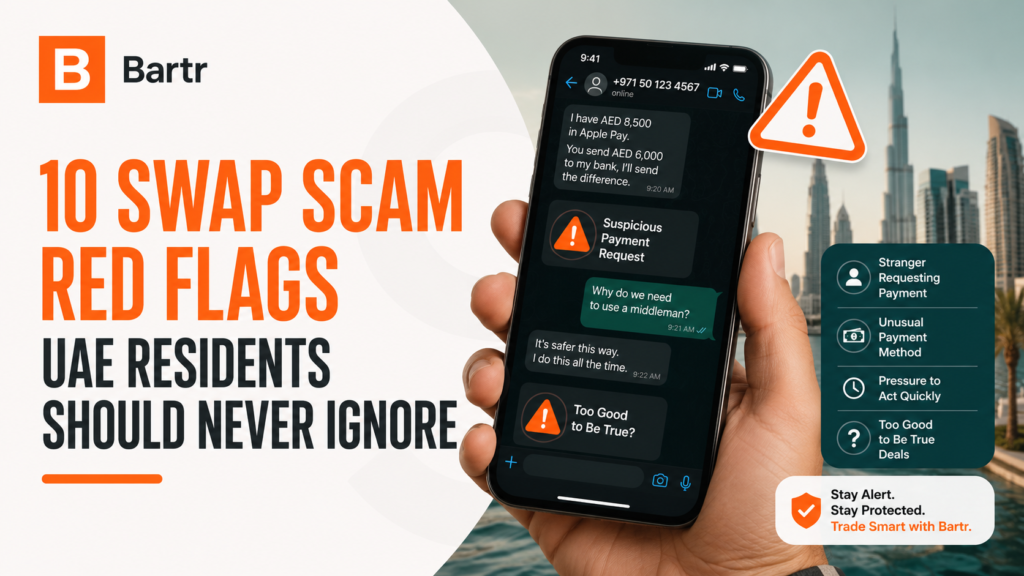
Fraud rarely looks amateurish any more. A suspicious account may write clearly, use realistic photos, respond promptly and seem entirely friendly.
That is the point. Judging safety by how polished a message looks is exactly the instinct being exploited. What actually separates a genuine swapper from a scammer is not tone — it is what they ask you to do.
Almost every scam ends in one of three requests: send money, share a code, or click a link. If none of those appear, you are probably fine. If one does, stop.
A generous trade can be genuine. An extreme mismatch deserves questions. Desirable phones, consoles and luxury items are used as bait precisely because they make people act before checking. Compare the model, condition and included accessories against realistic second-hand expectations — our guide to valuing an item fairly gives you the baseline.
Be cautious when someone refuses to discuss basic details in the app and insists on an unfamiliar website, a private payment page or a disappearing-message service. Moving the conversation removes the record of what was promised and the ability to report.
An OTP is a key, not a courtesy. Never share a login code, banking code, UAE Pass code or password with another user, for any reason and under any explanation. No legitimate swapper needs access to your account to arrange a meetup.
The classic version: a courier will collect the item, but first you need to pay a small refundable fee, an insurance charge or an account upgrade. Stop the moment a local exchange depends on you transferring money to release anything. Bartr arranges no couriers and holds no deposits.
Never enter card details, banking credentials or passwords into a link another user sends you. Type the official website or app name yourself. And treat screenshots of payment confirmations as decoration — they prove nothing about whether funds exist or are final.
Ask for a current photo of the item with one agreed detail visible — the day’s date on a piece of paper works well. Refusal, repeated excuses or obviously edited images suggest copied photos, or an item the person does not actually have.
“Decide in five minutes.” “Several people are waiting.” “Send it now or I move on.” These exist to shorten your thinking time. Genuine users can have real deadlines, but they will not prevent you inspecting the item or verifying basic facts.
Watch for inconsistent names, locations, numbers or explanations about who owns the item. One inconsistency may be nothing; several are a reason to stop. And never treat identity documents sent in a chat as proof — documents can be stolen or altered, which is also why you should not send yours.
A last-minute switch from a mall or cafe to a quiet road, a private room or a remote car park is a serious concern. Decline and hold the agreed public place. If they will not, cancel.
Aggression is not negotiation. End the conversation, block the account and report it. Do not keep talking to prove a point or salvage the deal.
Seeing how these actually unfold makes them much easier to spot in the moment.
A well-written profile offers a desirable phone for a modest item of yours. They cannot meet — they are travelling, or the item is with a relative in another emirate. No problem: a courier will handle it. Shortly afterwards a message arrives, often looking like a delivery notification, saying the shipment is held pending a small refundable insurance fee. Pay it, and the fee grows: customs, then a release charge.
Where it breaks: the moment a local swap depended on you sending money. Bartr arranges no couriers and holds no deposits. Nothing was ever going to be delivered.
A friendly buyer wants to “verify you are a real seller” before meeting. They will send a code to your number, and you just read it back. The code is in fact a login or password-reset code for one of your own accounts, triggered by them at that moment.
Where it breaks: no verification process ever requires you to read a code aloud to another user. Any request for an OTP is an attempt to take an account, without exception.
The UAE provides official channels for reporting cyber-enabled fraud through the police and eCrime services in each emirate. The government portal’s guidance on cyber safety and digital security explains how to protect your accounts, and consumer protection covers your rights more broadly.
Most marketplace fraud depends on distance — money moving before goods, or goods shipped to someone you will never meet.
Swapping removes that structure. Every Bartr exchange happens face to face in a public place, both people inspect before anything changes hands, and no money passes through the platform at all. There is no payment to intercept and no delivery to fake.
That does not make you immune, but it does mean the common scams have to work much harder — which is why nearly all of them start by trying to move you somewhere else.
The full handover routine is in our safe swap meetup checklist, and ratings and reviews explain how reputation makes reliable people easy to find.
Yes. The target may be the item itself, your account, your personal data or your login credentials. Treat requests for identity documents and OTPs as seriously as requests for money.
No. Identity images can be stolen, edited or reused. Avoid requesting or sharing identity documents in casual marketplace conversations — it creates risk on both sides without proving anything.
Close the page. Change any password you may have entered, enable two-factor authentication, and contact your bank immediately if you entered financial details. Keep the evidence and report it through official channels.
No. End contact, preserve evidence and report the account. Continuing the conversation only creates more risk.
Bartr is built around in-person exchange, and courier arrangements are a common feature of scams rather than a normal part of swapping. Meet in public and inspect instead.
Look at their completed swaps and reviews, ask for a fresh photo of the item, and see whether their answers stay consistent with the listing. Consistency over several messages is worth more than any single credential.
A missed deal costs nothing; a rushed one can cost far more. Keep your Bartr conversations clear, local and verifiable — and report anyone who asks for codes, fees or links.