Market Insights
E-Waste in the UAE: How Swapping Electronics Cuts Landfill and Saves Money
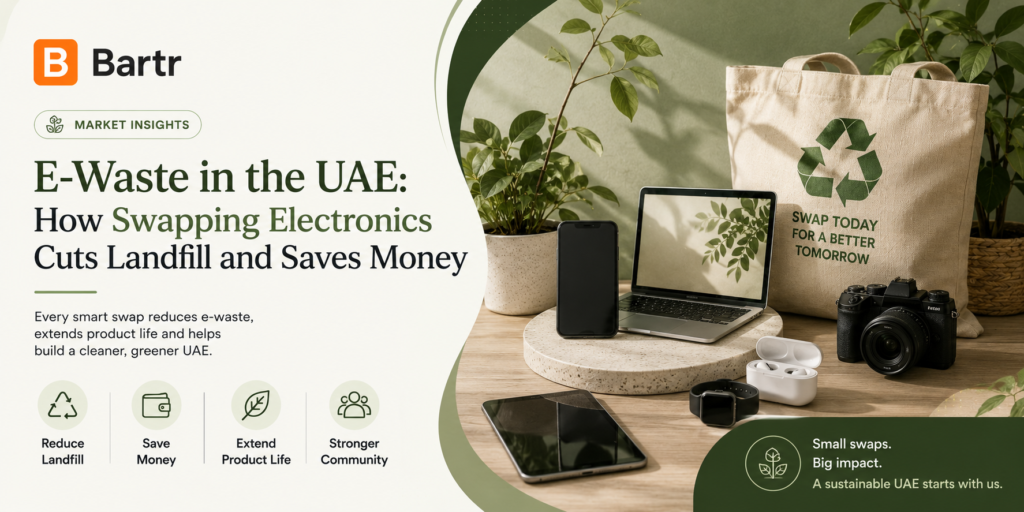
Almost every UAE household has one: a drawer with a phone two generations old, a tablet nobody uses, a set of headphones, and three chargers for devices that have long gone.
None of it is broken. It was replaced. And because nobody quite decides what to do with it, it sits there until a move forces the issue — at which point it usually goes in a bin bag.
Multiplied across millions of households, that is the whole e-waste problem in miniature. It is also unusually easy to fix, because a working device is worth something to someone else right now.
Recycling has a good reputation, and it earns some of it. But it sits well down the list of preferable outcomes, not at the top.
The reason is simple: recycling recovers materials. It does not recover the design, the assembly, the components or the transport. A recycled phone becomes a small quantity of metals. A reused phone stays a phone.
This ordering is not an opinion; it is how waste policy is structured. The UAE treats e-waste as a material requiring proper management rather than general disposal — see the national waste management guidance and the wider strategy from the Ministry of Climate Change and Environment.
For electronics, the environmental cost is concentrated in production rather than use. Mining, refining, component fabrication and global shipping all happen before the device reaches anyone, and charging it for a few years is a small fraction by comparison.
That leads to a counter-intuitive but important conclusion:
Keeping an existing device in use is almost always better than replacing it with a more efficient new one. The replacement starts with a debt that years of efficiency gains rarely repay.
So when a phone moves from one owner to another instead of being replaced by two new handsets, the saving is not marginal. It is the entire footprint of a device that never had to be made.
You do not need a carbon calculator to see it. Just count owners: one owner then landfill puts the full cost on one person’s use; two owners roughly halves it; three cuts it again. The object never changes.
This is the rare sustainable choice that leaves you better off rather than poorer.
Swapping a device you have stopped using for one you need avoids paying retail for the upgrade — and avoids the discount you would take selling it. Both sides of that gap stay with you.
It also beats a shop trade-in for most people, because a voucher only has value if you were already going to shop there. See our comparison of phone trade-in vs swapping.
It helps to be concrete about the contents of a typical unused-electronics drawer, because the total surprises people.
A phone two generations old, a working tablet, a pair of headphones, a smartwatch nobody charges and a bundle of cables is not scrap. For someone furnishing a first apartment, starting a new job, or buying a first phone for a child, that is a genuinely useful set of things — and every one of them would otherwise be bought new.
The reason it sits in a drawer is not that it lacks value. It is that no single item feels worth the effort of a sale on its own, so the decision gets deferred indefinitely and the value quietly decays. Devices lose worth every month they sit unused, and batteries degrade whether or not anything is switched on.
Swapping removes the part that causes the deferral. There is no price to research, no listing to defend and no haggling — just a question of whether two people each want what the other has.
Do this in order, and do the reset last:
The test that settles it: after the reset, the next owner should see a normal first-time setup screen — not a prompt for your credentials. If that prompt appears, the device is locked and worth almost nothing until it is released.
Include the correct charger and cable. A device handed over without its charger is less likely to actually get used, which defeats the point.
The UAE publishes useful background on data protection laws, and the full testing sequence is in our used electronics swap checklist.
People underestimate this constantly. Beyond phones and laptops:
Cables in particular are worth bundling rather than binning. Somebody furnishing a first apartment needs exactly that box.
Some devices should not be passed to another person, however tempting it is to let someone else decide:
Passing these on transfers a risk rather than a benefit, and a warning attached to a hazard is not the same as not giving someone a hazard.
Use an authorised e-waste channel in your emirate instead — never general or bulky waste, where batteries can leak or ignite. For Dubai, service details are on the Dubai Municipality website; other emirates run equivalent schemes, and several retailers operate take-back programmes for old devices.
Two questions, asked at the right moments, do most of the work.
Before replacing: does this device still meet my needs, or would a smaller fix — a battery replacement, more storage, a clean install — do the job? A battery swap is often the difference between a phone that feels finished and one that has two good years left.
When moving on: swap first, recycle only what is genuinely finished. That order is the entire strategy.
It is also worth clearing the drawer on a schedule rather than waiting for a move. Anything you have not used in six months is a candidate, and it is worth more today than it will be next year. More on the wider habit in why swapping is a sustainable habit, and on the market itself in the rise of the UAE swapping market.
For a working device, clearly yes. Reuse keeps the entire device in service and avoids new manufacturing; recycling recovers only materials and still consumes energy. Recycle what is genuinely broken.
Back up, sign out of every account, disable activation locks and tracking, remove SIM and memory cards, then run the official factory reset — not a manual deletion of folders.
Take it to an authorised e-waste channel in your emirate. Never place it in general or bulky waste, and never pass on a swollen battery or water-damaged device to another person.
Yes. Every extra year a device stays in use delays it becoming e-waste and avoids the manufacturing footprint of the replacement that was not needed.
Very much so, as a bundle. Chargers, adaptors, hubs and docks are exactly what someone setting up a new home is looking for, and they are otherwise pure drawer clutter.
Often, yes — particularly for batteries and screens. A repair keeps almost all of the original device in service, which beats both swapping and recycling on impact.
Give your old tech a second life. Open Bartr, swap the electronics you no longer use, and recycle only what is truly finished.