Barter Guides
Phone Trade-In vs Swap in the UAE: Why a Voucher Can Cost You
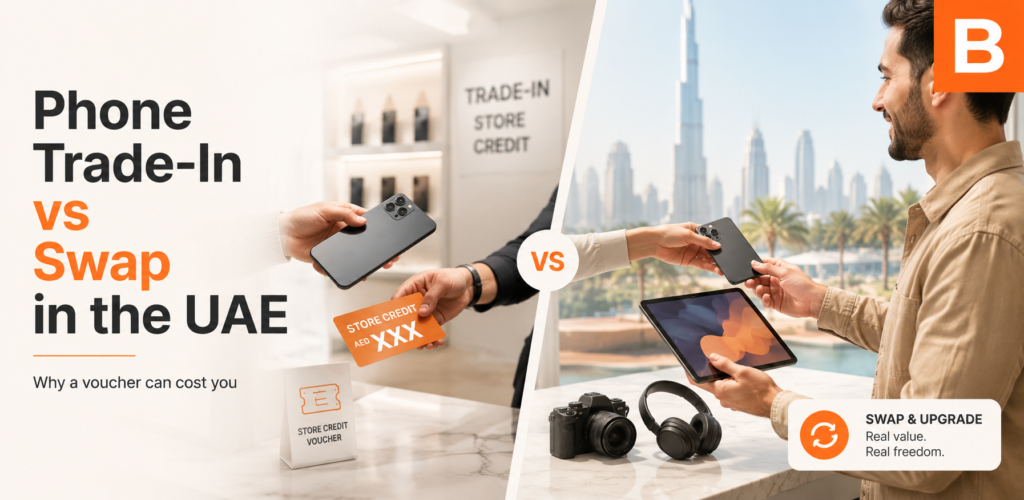
Both get rid of your old phone. What comes back is completely different.
Trade-in: you hand the phone to a shop and receive credit to spend in that same shop. The shop sets the value. The credit usually expires.
Swap: you trade directly with another person and receive an actual item. You both agree the value. Nothing expires.
Every other difference below follows from that one.
Store credit only has value if you were already going to shop there. Otherwise it is a discount on a purchase you did not plan to make.
Here is the trap that catches people. You take AED 400 of credit toward a new phone. You did not need the newest model, but the credit makes it feel almost free — so you spend more than you intended. The “discount” just increased your total outlay.
Credit is also stuck in one place. It cannot become:
A swap can become any of those, because the other side of the trade is whatever someone nearby happens to be offering.
Automated trade-in tools ask you a short series of questions and produce a figure. Those tools are built to protect the retailer from unpleasant surprises when the device arrives, which means they grade cautiously by design.
A phone in genuinely excellent condition — no marks, healthy battery, box and charger included — is often placed in the same bracket as one that is merely working. There is no field for “looked after carefully for three years”.
A person swapping with you does have that field. They can see the phone, test it, and weigh the condition themselves — and they are comparing it against buying new, not against a wholesale price. That gap is where the extra value sits.
Trade-in wins on speed and certainty, and there are four situations where it is clearly the right call:
For a low-value or damaged phone, that convenience is often worth more than squeezing out the extra.
Swapping wins on value and choice. Choose it when:
The flexibility is the underrated part. A phone can become a tablet, a laptop, a camera, furniture or anything else two people agree on — and it does not have to be another phone. See the most swapped item categories in the UAE.
Worth naming as the third option, because it suits some people better than either.
Selling gives you cash rather than credit or an item, and for a current flagship in good condition it is often the strongest route — demand is high and the price is easy to research.
For anything older, selling means accepting a discounted price and then paying near-retail for whatever you actually needed. That round trip is exactly what swapping removes. More in bartering vs selling, item by item and swapping vs selling.
Three questions:
Two or more “yes” answers to the last two? Swap it. A clear “no” to the third, or a badly damaged phone? Take the trade-in and move on.
They rarely match exactly, and that is normal rather than a problem.
Swap plus cash handles it: both people agree the items are a fair match, then settle a small difference in person at the handover. No fees, no commission, nobody feels short-changed. The one rule is to agree the amount in the chat beforehand, never at the meetup. See how swap plus cash works and how to value your item for a fair swap.
This sequence matters whichever route you choose, and the order is deliberate:
Demonstrate the phone works before the reset, then reset just before handover. Reset it at home and you have nothing to show.
The test that settles it: after the reset, the next owner should see a normal first-time setup screen, not a prompt for your credentials. If that prompt appears, the device is locked and worth almost nothing until you release it — so check it together, at the meetup. Full sequence in the used electronics swap checklist, and the UAE publishes useful background on data protection laws.
Every Bartr exchange happens face to face, so you can check the device before handing yours over.
Full routine in our safe swap meetup checklist, and the warning signs in 10 swap scam red flags. The UAE government portal also covers cyber safety and consumer protection.
You have a three-year-old handset in excellent condition, with box and charger. You do not need a new phone — you need a tablet for reading.
A trade-in tool offers AED 380 in store credit, expiring in ninety days, at a retailer you rarely use. So you list the phone instead: exact model, storage, battery health, five photos including a small scuff on the frame, and “looking for a tablet or e-reader”.
Three days later someone offers a tablet in good condition. You agree it is worth slightly more, so you add AED 100 — confirmed in the chat two days ahead. You meet at a cafe, test both devices for ten minutes, they reset the tablet, you reset the phone, done.
You end up with the thing you actually wanted, having spent AED 100 instead of AED 380 of credit you would have had to spend somewhere.
Every working phone that changes hands directly is one less device manufactured and one less sitting in a drawer. For electronics, most of the environmental cost is spent in production — before the device is ever switched on — so a second owner roughly halves the impact per person.
And where a device genuinely is finished, it belongs in an authorised e-waste stream rather than a general bin. See e-waste in the UAE and the official waste management guidance.
It depends what you want. Trade-in is faster and gives certain store credit. Swapping takes a little more effort but gets you a real item of your choosing, with no fees and no pressure to spend more.
Yes. Shop trade-ins are locked to one retailer and usually one category. A swap is not — a phone can become a tablet, a laptop, a camera, furniture, or anything both people agree on.
Not always. A direct swap is item for item. If the values do not line up, agree a cash difference in the chat beforehand and settle it in person.
No. The app is free to download, listing is free, and there is no commission on any swap.
Back up, sign out of all accounts, disable activation lock and tracking, remove SIM and memory cards, then run the official factory reset — after demonstrating the phone works.
Walk away. You are never obliged to continue. A cancelled swap costs you one trip; a bad swap costs you the phone.
Before you accept a voucher, see what your phone could actually become. List it on Bartr and browse what people near you are offering.