Category Guides
Building a Home Gym in the UAE: Space, Equipment and What to Check
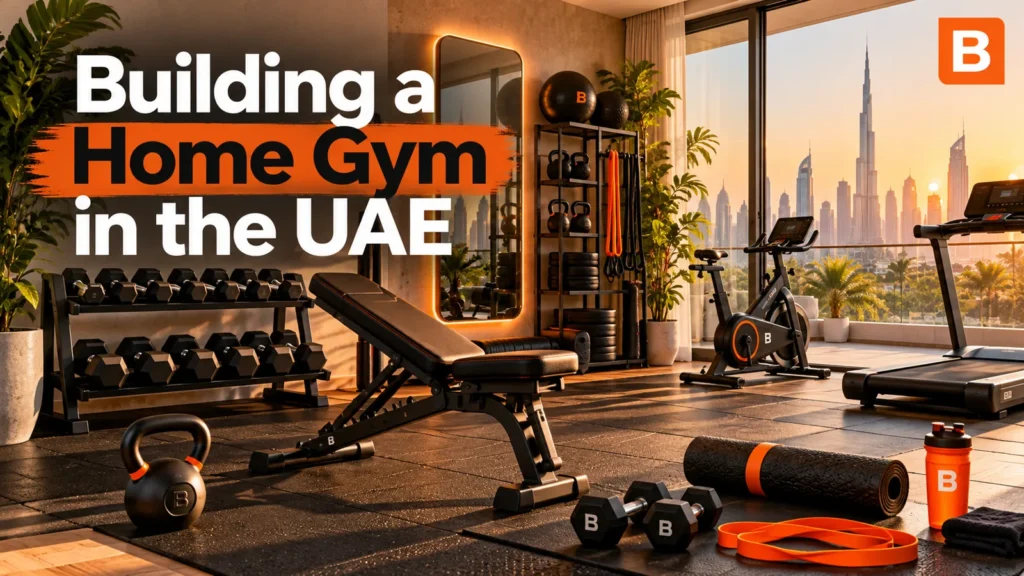
For a large part of the year, training outdoors in the UAE is limited to early mornings and late evenings. Gym memberships add up, and commuting to a gym eats into the time you meant to train. A home setup removes both problems.
It also does not need to be expensive. Home gym equipment is one of the most frequently passed-on categories in the UAE — bought with enthusiasm, used for a few months, then left in a spare room until a move forces a decision. That creates a steady supply of good-quality equipment for anyone willing to collect it.
Most home gym mistakes are space mistakes. Before choosing anything, check:
Rubber flooring tiles are cheap, easy to find second-hand, and protect both your floor and your relationship with the flat below.
For most apartments, the compact strength setup gives the most training value per square metre. Add one cardio machine only if you know you will use it.
Adjustable dumbbells save a great deal of space. Fixed dumbbells are simpler and nearly indestructible. Either is ideal second-hand.
Treadmills are heavy, noisy and the most likely to have hidden problems. Test them properly.
Both are quieter and lighter than treadmills, and generally more reliable second-hand. Check resistance across the whole range, the seat and its adjustment, and for rowers the chain or strap and the smoothness of the slide.
Ideal for villas and garages. Check the rack is square and stable, that safety arms or pins are included, and that the barbell spins and is straight. Plates should match the bar’s sleeve size.
Gym equipment is where enthusiasm meets physics. A treadmill can weigh as much as a sofa, and plates add up quickly.
The same approach that works for furniture works here. See swapping furniture in the UAE.
Weights barely age. A dumbbell from ten years ago does the same job as one bought yesterday. That means the gap between what new equipment costs and what used equipment is worth to a buyer is unusually large — and the person who benefits most is someone who swaps.
Swapping is also the easiest way to change your setup as your training changes: trade a treadmill you rarely use for a set of adjustable dumbbells, or a full set of plates for a rower when you move to a smaller flat. More in swapping sports and fitness equipment.
Without a coach or gym staff, safety is your responsibility. Learn technique before adding weight, use safety arms or spotter pins for heavy barbell work, and keep children away from machines and stacked weights. If you are new to training or have a health condition, speak to a doctor first.
Ventilation and temperature matter too. A spare room with poor airflow can become very warm; a fan or air conditioning and water within reach make a big difference.
The cooler months, around the Dubai Fitness Challenge, bring a surge of interest in fitness — and in equipment. The weeks before the challenge, and again in January, see more listings and more competition. Starting a little earlier gives you better choice.
Once the core kit is in place, a handful of inexpensive items makes the space far more usable:
Most of these are cheap, light and among the most commonly swapped fitness items, so they are rarely worth buying new.
A home gym is not for everyone. Gyms offer a wider range of equipment, classes, coaching and the motivation of other people. Home training wins on convenience, privacy and time saved travelling.
Many people combine the two: a compact home setup for most sessions and a class pass or occasional gym visit for variety. Swapping makes that easy to try without commitment. If home training does not stick, the equipment can be passed on with little lost.
A resident in a one-bedroom apartment wants to stop paying for a gym. They measure a corner of the living room and decide on the compact strength setup.
They swap a rarely used electric scooter for adjustable dumbbells and a bench from someone relocating. A neighbour gives them rubber floor tiles. They pick up resistance bands and a mat in another swap. For one cardio option they choose an exercise bike rather than a treadmill, because it is quieter for the flat below.
The whole setup fits in two square metres, cost nothing in cash, and is used four times a week.
Gym equipment listings work best with numbers: weight ranges for dumbbells, maximum user weight for benches and machines, and dimensions for anything large. Include how it comes apart and how many people are needed to move it, plus floor and lift access at your building. For cardio machines, mention when it was last used and offer to run it at the meetup. Buyers will travel further for a well-described set of weights than for a vague “gym stuff” listing.
When collecting, bring a trolley, straps and enough people, and agree beforehand who dismantles what. Check bolts and pins again once the equipment is reassembled at home, before your first session.
Adjustable dumbbells, a folding bench, resistance bands and a mat cover most training in a small space. Add an exercise bike if you want quiet cardio.
Yes. Weights, benches and racks are very durable. Test cardio machines carefully before agreeing.
Run it at several speeds and inclines, listen for noise, check the belt for wear and tracking, and test the emergency stop.
It can. Use rubber flooring, avoid dropping weights, and choose an exercise bike or rower over a treadmill if noise is a concern.
Many buildings have rules for moving heavy items and booking the service lift. Check with building management first.
Swap it. Weights and benches hold their usefulness for years and are in steady demand.
Build your home gym without the gym price. Find equipment — or pass on what you do not use — free on Bartr.