Category Guides
Dubai Ride: Choosing, Checking and Preparing a Bike
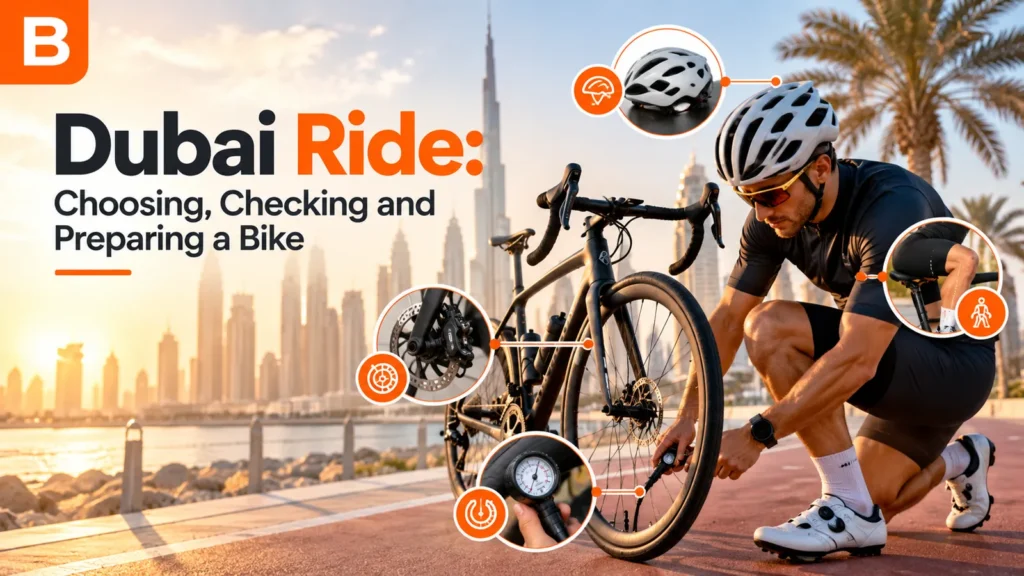
Dubai Ride is the cycling counterpart to Dubai Run, held during the Dubai Fitness Challenge. Sheikh Zayed Road closes to cars and opens to bikes, with a family-friendly route and a longer route for more confident riders. It attracts first-timers on borrowed bikes as much as experienced cyclists.
Dates, routes and entry rules change each year. Check the official Dubai Fitness Challenge site, and the RTA for road closures and cycling facilities.
For most first-time riders, a hybrid is the best choice: comfortable for the event and useful afterwards.
Bikes are one of the best second-hand categories in the UAE. Many are bought with good intentions, ridden a few times, and parked on a balcony. A well-kept bike that has had little use is worth far more to a new rider than it would fetch in a quick sale.
A bike that does not fit is uncomfortable and harder to control, whatever its condition. Stand over the top tube with both feet flat: you want a little clearance. When seated with the pedal at its lowest point, your leg should be almost straight. Frame sizes vary between brands, so test-ride it rather than relying on the label.
Sun and humidity are hard on bikes stored outdoors. Perished tyres and rusty chains are common and cheap to replace; a cracked frame is not. Prioritise the frame.
Be cautious of bikes priced far below their value, sellers who cannot explain the bike’s history, or anyone unwilling to meet at their home or a public place. Asking for the original purchase receipt is reasonable for a higher-value bike. See swap scam red flags.
A helmet is designed to protect you once. After an impact, the foam inside can be compressed even when the shell looks perfect, and you cannot see that damage.
A second-hand helmet is only a good idea if you know its history — for example, from a friend who bought it and never crashed in it. Otherwise, put helmet money into the budget and swap everything else.
Most of these turn up regularly in swaps, often bundled with the bike.
A basic service before the event is the best money you will spend. A bike shop will check brakes and gears, lubricate the chain and true the wheels. If you are confident, you can do the basics yourself: pump tyres to the pressure on the sidewall, clean and lubricate the chain, and check every bolt is tight.
Then ride it. At least a few rides before the event day let you adjust the saddle and find any problems while there is time to fix them.
Getting a bike to the start is the most commonly overlooked step. Check whether your car has a rack, whether the Metro allows bikes at that time, or whether you can ride there.
The family route is designed for children and less experienced riders. Check the age and equipment rules for this year. Children’s helmets need to fit snugly; a helmet that has been passed through several siblings may be worth replacing.
Kids’ bikes are perfect for swapping. A child outgrows a bike long before it wears out, so swapping their outgrown bike for the next size up keeps them riding for free.
Dubai has an expanding network of cycle tracks, from city routes to dedicated desert tracks, and the cooler months are the best time to use them. The RTA publishes information on cycling facilities and rules.
If the event shows you cycling is not for you, pass the bike on while interest is high. A bike listed in the weeks after Dubai Ride finds motivated new owners quickly.
A few simple jobs keep a bike safe and pleasant to ride, and none needs special tools beyond a pump and a cloth.
Sand and dust are the UAE’s particular challenge. After a ride near the beach or desert, clean and re-lubricate the chain. Store the bike out of direct sun, which perishes tyres and fades paint.
Even the right frame size needs adjusting. Raise or lower the saddle so your leg is almost straight at the bottom of the pedal stroke. Set it level. Move the handlebars so you can reach them with a slight bend in your elbows. Small changes make a big difference to comfort over the longer route, and a bike shop can help if you are unsure.
A couple decide to ride the family route with their eight-year-old. They have one old mountain bike on the balcony. They service it themselves, swap their child’s outgrown bike for the next size up, and swap a spare games console for a hybrid with lights and a lock. They buy one new helmet for the child.
They ride twice a week for three weeks before the event, finish the route together, and keep cycling at weekends. One new helmet was the only purchase.
A good bike listing answers the questions every rider asks first. State the frame size, wheel size and type, when it was last serviced, and anything included such as lights, a lock or a pump. Photograph the whole bike from the side, then the drivetrain, the brakes and any marks. Be honest about wear: a stretched chain or tired tyres are cheap fixes that most riders accept when they know in advance. Offering a test ride at the meetup builds trust quickly.
Any roadworthy bike with working brakes. A hybrid is a good all-round choice. Check this year’s rules for e-bikes and children.
Yes, if you check the frame, brakes, gears, chain, tyres and wheels, and test-ride it.
Only if you know its history. Impact damage can be invisible. When in doubt, buy new.
Stand over it with a little clearance, and when seated your leg should be almost straight at the bottom of the pedal stroke. Test-ride before agreeing.
There is usually a family route. Check this year’s age and equipment rules on the official website.
Keep riding on Dubai’s cycle tracks, or swap it while demand is high if cycling is not for you.
Find a bike, or pass on the one on your balcony. Swap it free on Bartr before Dubai Ride.