Category Guides
Swapping Furniture in the UAE: Measurements, Moving and Handover Tips
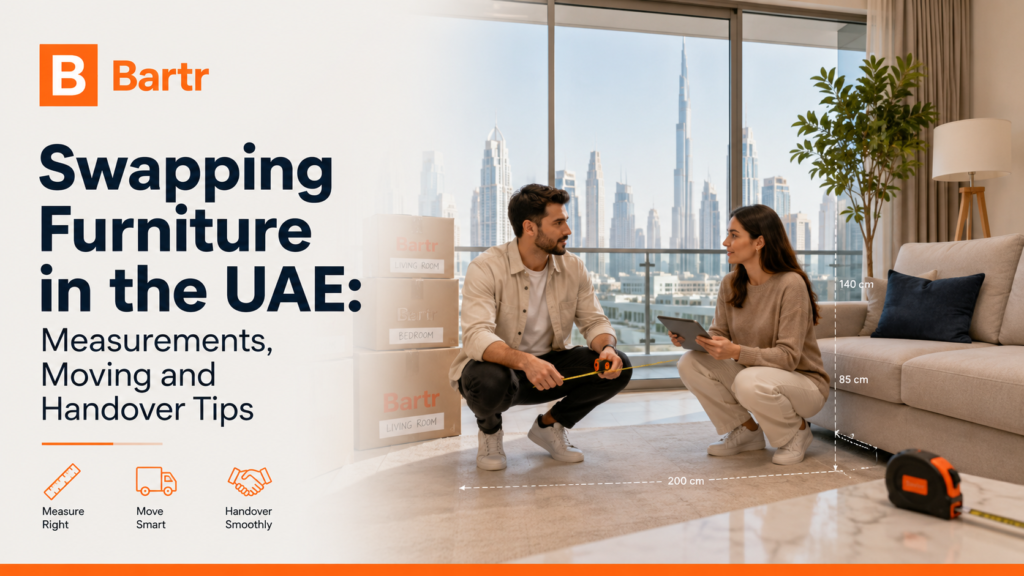
Almost never because of the item. Furniture trades collapse for logistics: the piece fits the room but not the doorway, the service lift was not booked, or nobody agreed who was carrying it.
That is good news, because every one of those is preventable in a ten-minute conversation before anyone travels. Get the planning right and furniture is the most rewarding category on Bartr — the items are expensive to replace, and the person receiving yours is comparing it against a shop, not a wholesale price.
Most people measure width and height. That is roughly a third of what matters.
Width, height and depth — plus the diagonal, and anything that cannot be removed. For a sofa, measure with and without the feet. For a wardrobe, remember it has to rotate on its way through a door, so ceiling height matters too.
Wall or floor area, allowing for skirting boards, sockets, radiators, door swing and enough space to walk past.
This is the one that catches people out. Apartment door, corridor turns, staircase width, lift door opening and the service-lift interior. A sofa that fits the room can still fail at a single narrow turn two floors below.
Show the front, back, sides, legs, corners, underside and every detachable part. Then disclose the flaws plainly:
Accurate detail does two jobs. It prevents the renegotiation that kills swaps at pickup, and it lets the other person work out whether they need wrapping, tools or a second pair of hands. See our guide to photographing items.
Do not assume every bed, wardrobe or table can be taken apart and rebuilt. Flat-pack furniture in particular does not always survive a second assembly — cam locks strip, and particle board loses its grip.
Before agreeing:
Do this only once the swap is firmly confirmed. A dismantled wardrobe sitting in your hallway for a week is a much worse position than an assembled one.
Many UAE buildings have service-lift schedules, loading-bay rules, move permits and security procedures — and weekend or evening access often differs from weekdays.
Confirm with building management before you set a collection time, not after. Then:
Share only the access information needed for the collection, and have another adult present. Keep the item near the entrance or loading area rather than deep inside the home — see our safe swap meetup checklist for the home-pickup section.
There is no universal rule, which is exactly why it must be agreed in writing. Three common arrangements:
Transport cost can change whether a swap is worth doing at all, so raise it early rather than discovering it on the day. If one side is paying noticeably more, that is a fair thing to reflect in a small cash difference — see how swap plus cash works.
Cosmetic wear is normal and negotiable. Safety problems are not.
Sit on chairs and sofas properly. Open every drawer. Check joints, and look underneath — the underside tells you more about a piece’s history than the top ever will.
Walk away from: active pest signs, serious mould, unstable structural components, and damaged safety glass. None of these are worth a discount.
Mattresses and heavily upholstered sleep products are their own category: hygiene history is very difficult to verify, so apply a higher standard and follow manufacturer or health guidance when in doubt.
Reconfirm the day before, and again before anyone sets off. Then:
That last one matters more than it sounds. A wardrobe without its shelf brackets is a very different item from the one that was listed.
You are leaving a two-bedroom apartment and want to trade a three-seat sofa for a compact desk and shelving.
You list the sofa with six photos including the underside, note a small tear on the left arm, give full dimensions with and without the feet, and state that collection must happen before the 28th. Someone in the next tower offers a desk and a bookshelf.
Before agreeing, you both check: their desk fits your car, your sofa clears their corridor turn, and both buildings can book a service lift on the Saturday morning. They bring straps and a friend; you empty the sofa and have it by the door. Twenty-five minutes, one trip each, no money.
The whole thing worked because the corridor turn was checked on Tuesday, not discovered on Saturday.
Furniture demand in the UAE is not steady through the year. Departures cluster through the summer and arrivals cluster around the start of the school year, which means the people most likely to want your dining set are looking for it in a fairly narrow window.
List early in that window rather than in the final week before your own handover. A piece offered with three weeks of runway attracts calm, motivated offers; the same piece offered with three days left attracts people who know you are out of options.
If a piece is unsafe, damaged beyond practical use, or simply attracts no offers before your deadline, use an authorised route rather than leaving it in a corridor or bin area.
Dubai Municipality operates a bulky-waste collection service for items such as furniture and appliances, subject to its current conditions — details are on the Dubai Municipality website, and the national approach is set out on the UAE government’s waste management portal. Other emirates run equivalent services.
Plan for this in advance. Our swap-first decluttering plan covers the timeline, and furnishing a first apartment by swapping covers the other side of the same trade.
There is no fixed rule, so agree before confirming. The person receiving the larger item usually arranges pickup, but distance and value are fair things to weigh — and a cash difference can balance it.
Only once the swap is firmly confirmed and you know the piece can be reassembled. Photograph the screw positions, and keep every piece of hardware bagged and labelled.
Width, height, depth, the diagonal, and the size of any detachable parts. Mention whether it dismantles, and be ready to discuss the removal route and lift dimensions.
Yes, when the damage is disclosed honestly and the piece is still safe and useful. Never hide structural weakness, pest signs, mould or broken safety glass.
Stop rather than force it. Damage to a lift, door frame or the item itself costs far more than a rescheduled collection. This is exactly what the route measurement is for.
Generally not. Hygiene history is hard to verify and most people will not accept one. Route it through a proper disposal or recycling channel instead.
List your furniture on Bartr with full dimensions and honest condition photos — then confirm transport and building access before you schedule the collection.