How-To Guides
How to Recycle Old Clothes in the UAE (and What Not to Recycle)
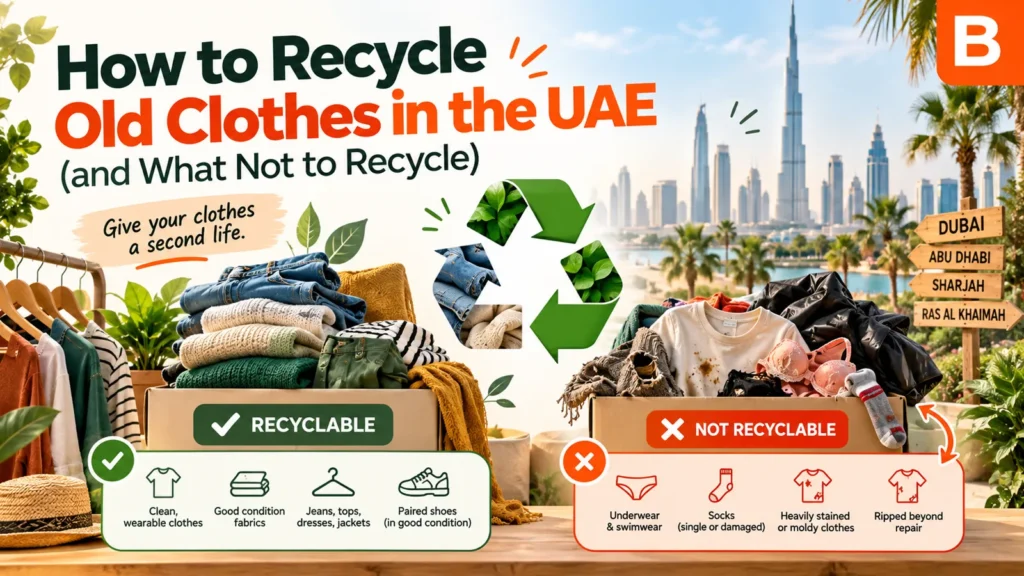
When people say “recycle old clothes” they often mean “get rid of clothes responsibly”. Those are different things. A wearable shirt put into a recycling stream is a wasted shirt; a torn, stained one put into a donation bag is a burden on a charity.
The most useful thing you can do is sort before you decide. Clothes someone could wear should go to people. Clothes nobody could wear are what textile recycling exists for.
This guide is about that second group — the worn-out, the stained, the stretched and the single socks. For wearable clothing, see how to swap clothes in the UAE and where to donate in Dubai.
The fourth row matters. Textiles soaked in oil, paint or chemicals, or that are mouldy, can spoil a whole batch of recycling. They are not recyclable and should not go in the bin.
Textile recycling and clothing collection bins in the UAE typically accept a wider range than people expect. Depending on the operator, that can include:
Rules differ between operators, so read the label on the bin. Some only accept wearable clothing for resale; others take all textiles for sorting and recycling. If a bin says “wearable only”, respect that.
What generally does not belong: duvets and pillows with filling, carpets and rugs, wet or dirty items, and anything contaminated.
The single biggest reason textiles fail to get recycled is moisture. A bag left beside a bin overnight can be ruined by humidity and sprinklers, and then it is just waste.
Single shoes are effectively unusable. Always pair them, tie the laces or band them, and bag them. Wearable shoes in good condition are better swapped or donated; worn-out pairs can go into textile collection where accepted.
Handbags, backpacks, belts and soft accessories are widely accepted. Empty every pocket first. A leather bag in good condition is worth far more swapped than recycled.
Old sheets and towels are often welcomed by animal shelters, which use them for bedding and cleaning. Ask before dropping off. Otherwise, textile collection usually takes them.
Repairs are usually quicker than people assume. A missing button, a loose hem or a broken zip is a small job at a tailor or with a basic sewing kit, and turns a “recycle” item back into a wearable one.
Clothes that are past wearing are still useful at home:
Even fabric for crafting can be swapped. People who sew actively look for interesting fabric, and listing “denim offcuts for crafting” finds them.
Knowing where your bag goes makes it easier to fill it properly. Collected textiles are generally sorted by hand into grades. The best wearable pieces are resold or redistributed as clothing. Lower-grade fabrics are cut into industrial wiping cloths. What remains can be shredded into fibre for insulation, padding or other materials.
Every step of that chain depends on the input being dry and uncontaminated. One wet or oily bag can spoil the items packed around it, which is why the preparation steps above matter far more than the volume you drop off.
It also explains why operators prefer wearable and worn-out items to be kept apart where they offer separate bins. Mixing them means a good jacket can end up graded as rags simply because it arrived in the wrong bag.
Most of these come from rushing a clear-out into a single afternoon. Splitting it into a sorting day and a drop-off day avoids nearly all of them.
Two categories are worth pulling out before anything goes near a recycling bin. School uniforms are specific to one school and expensive to buy new, so a family at the same school will usually want them even with light wear. List them with the school name and size. Formal wear, abayas, kanduras and occasion outfits are often worn only a few times and have a long second life; they are much better swapped than recycled.
Textiles are among the harder household materials to deal with once they reach landfill, because most clothing is a blend of fibres that does not break down simply. Keeping wearable clothes in use and sending worn-out ones to proper collection both reduce what ends up there.
The UAE’s approach to waste reduction is set out in the official waste management guidance. For Dubai residents, the Dubai Municipality website covers current collection services. For the bigger picture, see why swapping is a sustainable habit.
Clearing a wardrobe before a move, someone ends up with sixty items. Twenty are wearable and good enough to swap; they list six standout pieces and swap a winter coat for a lamp they need at the new flat. Fifteen go to donation. Five need small repairs; three are fixed, two move to recycling. Twenty are worn out — they keep four t-shirts as cleaning cloths, and wash and bag the rest for textile collection.
Nothing wearable was recycled, and nothing worn out burdened a charity.
Sort out anything wearable first, then wash, dry and bag the worn-out items and take them to a textile recycling or clothing collection bin that accepts them. Read the bin’s label for what it takes.
Yes, at bins that accept all textiles. They should be clean and dry. Items contaminated with oil, paint or mould should not be recycled.
Many do, if the shoes are paired and bagged. Check the label, as some operators only accept clothing.
Donate or swap anything wearable and clean. Recycle only what nobody could reasonably wear.
Animal shelters often welcome them; ask first. Otherwise use them at home as cleaning cloths or put them in textile collection.
Take the bag home and try again later or use another bin. Bags left outside get wet and become waste.
Before anything goes in a recycling bin, check whether someone could still wear it. List your wearable pieces free on Bartr and recycle only what is truly finished.