Expat Guides
Leaving the UAE? A Practical Swap-First Exit Checklist for Expats
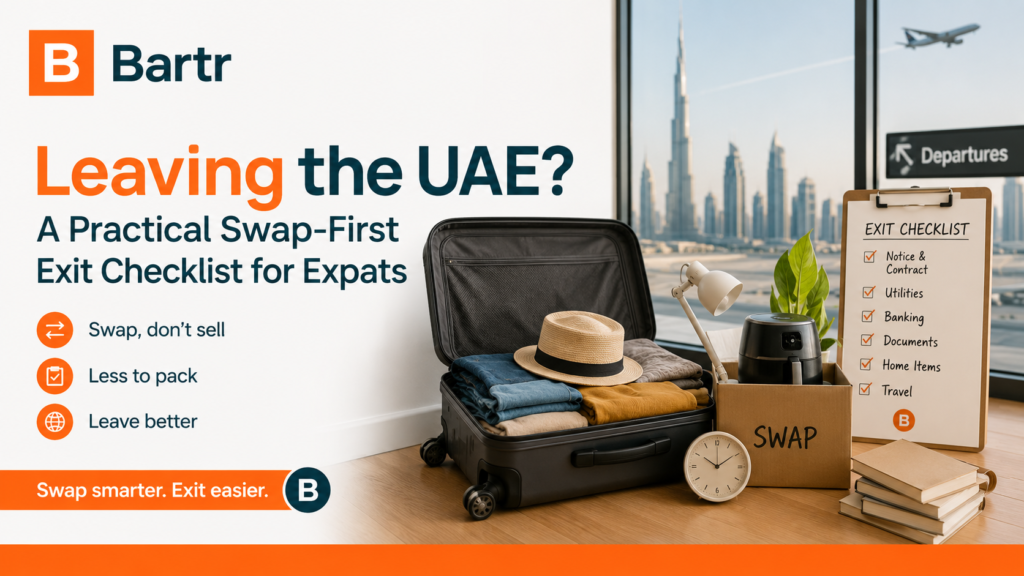
When you have a fixed departure date, the calculation shifts. The best exchange is no longer the one with the highest theoretical value — it is the one that actually completes, on time, without a last-minute scramble.
A reliable person who can collect on Thursday is worth more to you than an ideal offer from someone who has not confirmed anything. Every item still in the apartment on your final morning becomes a problem rather than an asset.
So the goal is different from an ordinary declutter: fewer, more certain trades, all finished before the last week.
Before listing anything, split your belongings three ways:
This one step prevents the most common relocation mistake: swapping away something your household still needs, then having to buy a replacement for your final fortnight.
List furniture, gym equipment, large children’s items, duplicate appliances and anything that will not travel.
For each one, record:
Check your tenancy agreement and building rules for move-out procedures now, not later. Many buildings require a permit, a booked lift slot or a security clearance, and those can take days. Full detail in swapping furniture in the UAE.
Clear photos in daylight, honest condition, and a stated collection window. Bundles work well here — kitchenware, books, tools, toys, home-office accessories.
Keep bundles coherent. A themed set someone can use immediately reads as an offer; a mixed pile of everything you have left reads as a clear-out, and gets treated as one.
Two things to say plainly in every relocation listing:
Being upfront about a deadline attracts the people who can meet it and filters out the ones who cannot.
Prioritise people who communicate clearly and can commit to a specific window, over people offering marginally more.
Confirm transport responsibility, dismantling and access in writing. Set a reasonable hold period rather than turning away other interested users for an unconfirmed pickup — a promise is not a collection.
For higher-value electronics, arrange the test and the account-removal process now. Keep your backups until the swap is fully complete, not until the day it is agreed. See the used electronics swap checklist.
Keep working until the end: one phone, a charger, an internet option, basic cookware, bedding, and cleaning supplies for the handover inspection.
Everything else that goes should go with its accessories. Pack cables with the correct device and label them — a laptop handed over without its charger loses a chunk of value and creates a follow-up conversation you will not have time for.
Before any device leaves your hands:
The UAE publishes useful background on data protection laws and on cyber safety and digital security.
Some things must be returned or destroyed, not passed on:
Return company and building property through the proper channel and get confirmation in writing. It is the kind of loose end that follows people across borders.
Relocation forces a decision most people never make deliberately: which possessions are actually worth an international shipping cost.
The rough test is replacement cost against shipping cost. Anything bulky, heavy and easily replaced at the other end — wardrobes, sofas, appliances, gym equipment, mattresses — rarely justifies the freight. Anything light, expensive, or genuinely irreplaceable travels with you.
Everything in the first list is a swap candidate. Working through it four weeks out is what turns a stressful final fortnight into a manageable one.
Relocation is exactly when no-shows hurt most, so make confirmation non-negotiable:
The day before: send the item, accessories, time, location, loading instructions and your final collection deadline. Shortly before collection: confirm again.
If someone does not confirm, release the item to the next person. That is not harsh — it is the only way to protect a fixed departure date. More on this in handling no-shows and ghosting.
Protect the last two days absolutely. Movers, cleaners and handover inspections should never depend on someone else arriving on time.
Some items will not find a match, and you need to know where they go before you are out of time.
Identify donation, recycling and authorised disposal options in week three, not week one. Electronic waste and bulky items should go through the proper services — never abandoned in corridors, stairwells, parking areas or beside communal bins, which can create a hazard and affect your handover.
For bulky waste in Dubai, check the current service conditions on the Dubai Municipality website; other emirates run equivalent services. The national approach is on the UAE government’s waste management portal, and our guide to e-waste and swapping electronics covers devices specifically.
Worth remembering: the person collecting your dining table is often someone who arrived last month with an empty apartment. Departures and arrivals hand off to each other between July and September, which is why relocation listings in that window tend to move fastest.
If you are moving within the UAE rather than leaving, use the swap-first decluttering plan instead — the timeline is shorter and you keep a needs list. And see furnishing a first apartment by swapping for what your items look like from the receiving end.
Bulky items three to four weeks out. Smaller items and bundles once the move-out plan is clearer, around two to three weeks.
Not automatically — check the person, the item and the logistics. But a reliable, timely exchange genuinely is worth more than an ideal offer that never gets confirmed.
List them with the availability date stated clearly, keep your backups, and book the final test and reset appointment in advance so it is not competing with your packing.
Personal documents, name labels, saved addresses, account details, memory cards, SIM cards, and any company or building access information.
Switch to donation, recycling or authorised disposal — which is why you identify those routes in week three rather than on your last day.
No. Listing, swapping and donating are all free, with no commission on any exchange.
Relocating soon? List your useful belongings on Bartr with clear availability dates and collection arrangements — and finish every pickup before your final week.