Barter Guides
Used Furniture Buyers in Dubai vs Swapping: What Your Furniture Is Worth
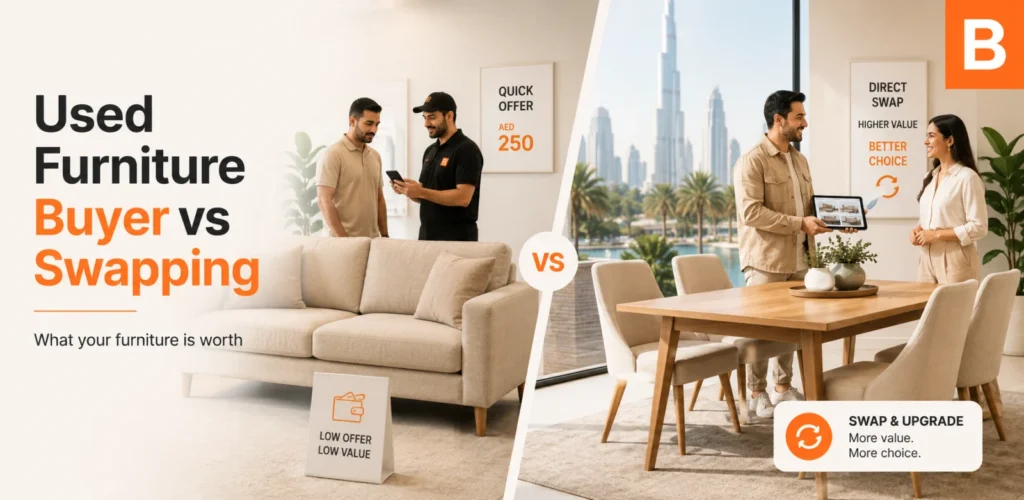
A used furniture buyer is running a resale business, and it is worth understanding the economics before judging the offer.
They collect from you, transport the item, store it, clean or repair it, photograph and list it, then hold it until someone buys. Every one of those steps costs money, and some items never sell at all — a loss the rest have to cover.
All of that comes out of the price they offer you. This is not unfair; it is simply what the service is. You are paying for speed, collection and certainty, and those are genuinely valuable things when you are days from a handover.
Same-day removal. No listing. No messages. No no-shows. No lifting. No arranging a service lift.
In a tight move-out window, that is worth a real amount — and anyone who tells you otherwise has not cleared a flat under deadline. The only question is whether it is worth the specific difference between their offer and what the item could return another way.
You cannot answer that without knowing what the item is actually worth, which is where most people go wrong.
Not by what you paid. The original retail price is close to irrelevant once an item has been used, and anchoring to it is the single most common reason people feel insulted by a fair offer.
Instead, spend ten minutes:
Two honest realities from that exercise: bulky items in poor condition are worth less than people expect, and clean, well-known pieces are worth more. Full method in how to value your item for a fair swap.
Four situations, and in all of them taking the offer is the correct decision:
And a fifth that matters more than the others: when the alternative is a deposit deduction. A low offer beats a removal charge every time, and leaving furniture behind can cost you considerably more than the item was worth. See will leftover furniture cost your security deposit?
Swapping wins when three things are true: the piece is in genuinely good condition, it is a useful size or style, and you have at least a week or two of runway.
It wins by a wider margin still when you need something yourself. A cash sale leaves you halfway — you have money and still no bookshelf, and the second half means paying near-retail for it. A swap finishes both halves in one meeting, and skips the resale margin entirely.
Furniture is one of the most actively exchanged categories in the UAE precisely because departures and arrivals overlap continuously, peaking July to September. Your sofa and someone’s empty apartment are the same problem from opposite ends. See swapping furniture in the UAE and furnishing a first apartment.
The single most useful habit here: before accepting any offer, list the item and see what comes back within three days.
You lose nothing. The cash buyer will still be there on Thursday, their offer will not have changed, and you will know considerably more than you do now.
To make those three days count:
Then set a switch-over date and hold to it. “If nothing is confirmed by Wednesday evening, I call the buyer” is a plan. “I will see how it goes” is how people end up leaving a sofa in a corridor.
Whichever route you choose, an hour of preparation changes the offers you get — and it works on cash buyers too, who are assessing resale potential rather than sentiment.
A wobbling, dusty sofa with a missing cushion cover reads as end-of-life. The same sofa cleaned, tightened and photographed well reads as a piece someone looked after — and that impression is doing more work in the offer than the actual condition difference justifies.
You have a three-year-old sofa in good condition and eleven days until handover.
A cash buyer offers AED 350, collection tomorrow. Before accepting, you spend ten minutes checking local listings: comparable sofas in similar condition sit around AED 900, so realistically yours is worth AED 550–650 to a private buyer.
You list it with dimensions, six photos including the underside, a note about a small mark on one arm, and “must be collected by the 24th”. You say you are looking for a compact desk or storage. Two days later someone in the next tower offers a desk and shelving unit, and can collect Saturday.
Total cost of testing the market: two days and about fifteen minutes. If nothing had come back by Wednesday, the AED 350 was still available.
Three questions, in order:
See also how to dispose of old furniture in Dubai for the seven routes compared, and classifieds vs swapping for the private-sale option. Whichever you choose, the UAE government portal sets out your consumer protection rights, and for anything genuinely finished, the Dubai Municipality bulky-waste service is the authorised route.
If you do decide on the cash-buyer route, it is worth getting more than one quote where time allows.
Offers for the same item vary more than people expect, because each business has different storage constraints, different resale channels and different views on what will move quickly. A piece one buyer values at very little may be exactly what another is short of that month.
Send the same photographs and dimensions to two or three, and be straightforward that you are comparing. Nobody is offended by that, and it takes about ten minutes. Even if you end up accepting the first offer, you will accept it knowing it was reasonable rather than hoping it was.
You can accept an offer from a used furniture buyer, which is fast but usually well below value, or list it yourself. On Bartr, listing is free: you can swap it, swap it plus a cash difference, or agree a price in the chat and settle it in person at collection.
They carry the cost of collection, transport, storage, cleaning and resale, plus the items that never sell. That all comes out of what they can offer you.
Compare it with similar items in similar condition listed locally right now, not with its original retail price. Then adjust for wear, completeness, style and how hard it is to transport.
Almost always. Three days of listing costs nothing, the offer will still be there, and the outcome is frequently materially better.
When you are within a few days of handover, when the item is bulky or heavily worn, when there has been no interest after a fair listing period, or when the alternative is a deposit deduction.
Sometimes, particularly if you have a competing offer or comparable listings to point to. Knowing the local market is what gives you something to negotiate with.
No. Listing and swapping are free with no commission, and any cash difference is settled directly between the two people.
Before you accept a same-day offer, spend three days testing the market. List your furniture on Bartr and see what comes back.