Barter Guides
Classifieds vs Swapping: Which Is Better for Second-Hand Items in the UAE?
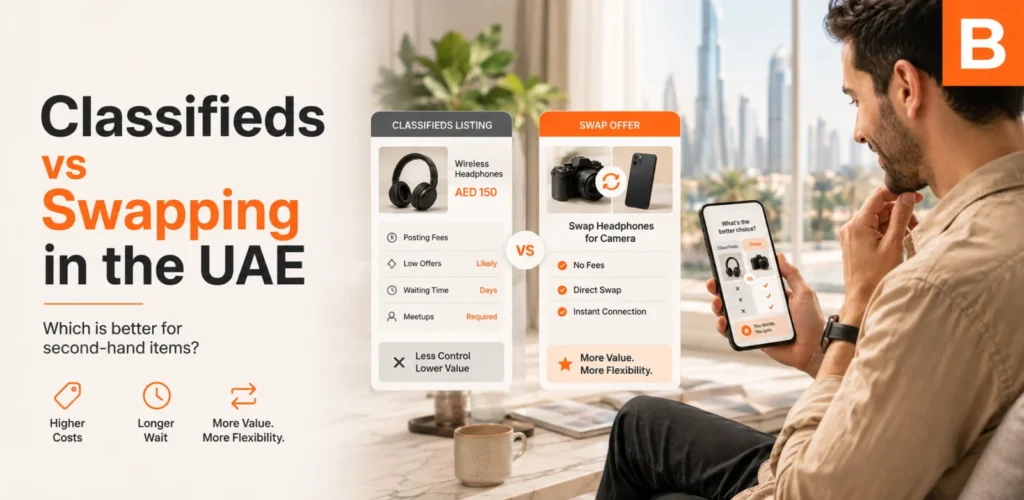
A classified listing turns your item into money. A swap turns it directly into another item.
That single distinction explains almost every practical difference between the two — the kind of messages you get, how long it takes, what it costs, and how it feels when it works.
So the useful first question is not “which platform is better?” It is: do I want cash, or do I want a thing? If you genuinely need money, classifieds are the right tool and nothing below changes that. If what you actually want is a replacement item, selling adds a step you did not need.
Selling asks you to set a number and then defend it. The moment a price appears, every message becomes a test of it — and “last price?” typically arrives before anyone has looked at the photographs.
Swapping changes the question being asked. Instead of “is this worth AED 400?”, both people are looking at two items and asking “is this a fair match?” That has an obvious answer far more often, and it is a much less adversarial thing to discuss.
It is not that swapping is effortless. Finding a match takes its own patience. But the effort goes into finding the right person rather than into arguing with the wrong ones.
This is the strongest argument for classifieds and it deserves a fair hearing.
Large classified platforms have far more users. For a common item — a standard phone model, an ordinary desk — that reach genuinely matters, and you will get more eyes on the listing faster.
The counterweight is relevance. A swap requires two people to each want what the other has, which is a narrower filter. But the people who pass through that filter are considerably more motivated, because they are not browsing for a bargain — they have a specific problem your item solves.
In practice that shows up as fewer messages and a higher proportion of them going somewhere.
Check what any platform actually charges before you list: listing fees, promotion or “bump” costs, featured placement, and any commission on completion.
Then add the two costs that are not on the fee schedule:
Put those together and a swap that looked like a slight loss on paper frequently comes out ahead. Bartr charges nothing to list or swap and takes no commission, so the full value of the exchange stays between the two people. More on this comparison in swapping vs selling.
It helps to understand that these platforms are not trying to do the same job badly — they are built around different assumptions.
A classifieds platform is optimised for volume and matching supply to demand at a price. Everything about it follows from that: search by category, sort by price, promoted listings, and a very large audience where most people are browsing rather than looking for one specific thing.
A swap platform is optimised for finding the two people whose unwanted items solve each other’s problem. That is a harder match to make and a smaller pool to make it from, but when it lands, both sides finish in one step rather than two.
This explains the thing people often find surprising: swapping can feel slower per listing and faster overall. You are comparing one process against two, and only counting the first half.
Neither model is inherently safer, because both end with two strangers meeting. The precautions are identical:
One structural difference is worth noting: because most swaps involve no money moving through any platform at all, several common marketplace scams have nothing to intercept. That does not make you immune — it means the scams have to start by moving you somewhere else, which is itself the warning sign.
See our safe swap meetup checklist and 10 swap scam red flags. The UAE government portal covers consumer protection and cyber safety.
Every platform has them, and the fix is the same regardless of which you use: a two-step confirmation.
Send the full details the day before — item, accessories, time, place, any cash difference. Then confirm again before either of you sets off. If the other person will not confirm the second time, do not travel.
Keep your listing active until the exchange has physically happened, and never hold an item on a promise. Full detail in handling no-shows and ghosting.
You have a desk you no longer need and you want a bookshelf.
Classifieds route. List the desk. Field several messages, mostly about price. Agree AED 250 with someone who then cancels. Relist, eventually sell for AED 200. Now start again as a buyer: search, compare, negotiate, arrange a second meetup, pay AED 220. Two listings, two meetups, roughly three weeks, AED 20 down.
Swap route. List the desk and say you are looking for a bookshelf. Someone nearby has the opposite problem. One meeting, both solved, no money at all.
The swap route is not always available — and that is the honest limitation. When it is, the difference is not small.
Choose classifieds when: you need cash specifically, the item is very common with strong demand, it is high-value with a real resale market, or there is nothing you want in return.
Choose swapping when: there is something specific you need, you would rather avoid pricing arguments, the item is worth more to the right person than on an open market, or you want to avoid fees entirely.
Most people should do both. Sell the ordinary things you want money for; swap the ones where you have a replacement in mind. See bartering vs selling, item by item and good trading platforms in the UAE. And when two items are close but not equal, swap plus cash closes the gap.
There is a personal fit question underneath all of this, and it is worth being honest about.
Some people find price negotiation straightforward and do not mind it. If that is you, classifieds will work well and you will extract close to market value. Others find the haggling genuinely unpleasant, drop their price simply to end the conversation, and finish worse off than the listing suggested. For them the pricing step is not neutral — it is the whole obstacle.
Swapping removes that step entirely, which is why people who dislike negotiating often do disproportionately better with it. Not because the mechanism is superior in the abstract, but because it asks them to do something they will actually follow through on.
Neither is inherently safer — both involve meeting a stranger, so the same precautions apply. Swapping does remove the payment step that several common scams depend on.
It depends on what you want. Selling gives cash at whatever price you can defend, minus fees. Swapping gives you an item you actually wanted, with nothing taken out of the exchange.
Yes, and most people should. Sell common items for cash and swap the ones where you have something specific in mind. They are not mutually exclusive.
Confirm the item, accessories, time and place in one message the day before, then again before travelling. If they will not confirm, do not travel.
For a single common item, classifieds usually find someone sooner. For the full journey — getting rid of one thing and acquiring another — swapping is generally faster, because it is one process instead of two.
No. Listing and swapping are free with no commission, and any cash difference is settled directly between the two people.
If you would rather end up with something you need than money you then have to spend, try a swap. List your item on Bartr and see what comes back.