Barter Guides
Good Trading Platforms in the UAE: Your Complete Guide to Trading Items Online
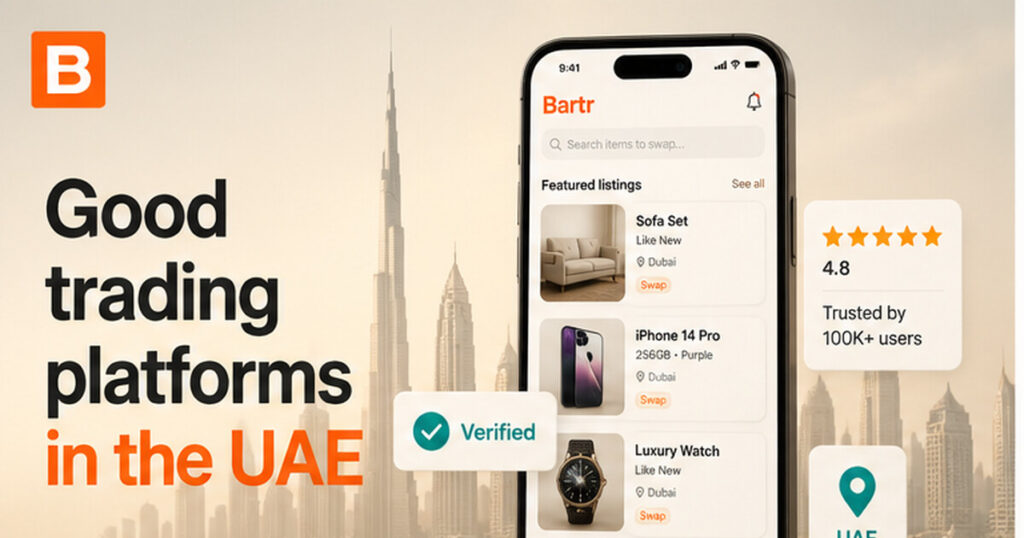
The phrase covers two things that behave completely differently, and choosing badly is usually a matter of picking the wrong type rather than the wrong brand.
Cash marketplaces connect a buyer and a seller. You list an item, someone pays for it, and you go and buy what you needed separately. Classifieds sites work this way.
Swap marketplaces connect two people who each have something the other wants. No money needs to change hands at all, and the trade finishes in one step instead of two.
Before comparing anything, answer one question: do you want money, or do you want a different item? Everything below follows from that.
Whether you are exchanging electronics, fashion or furniture, the same six things decide whether a platform is worth your time.
Profiles, ratings and reviews that reflect real completed exchanges. Without a reputation trail you are dealing with strangers and nothing else.
Listings you can actually reach. A great item in another emirate is not a great item if neither of you will make the drive.
Listing something should take minutes, not an evening. Friction at the listing stage is why most people never post the second item.
Both sides should know exactly what happens next: what is being exchanged, any cash difference, where you are meeting and when.
A platform is only as useful as the number of relevant listings near you. Thin categories mean long waits.
Listing fees, promotion fees and commissions quietly erode the point. For casual traders they often exceed the value of the trade itself.
These are not really competitors in the way the table implies. Most are optimised for turning an item into cash. Bartr is optimised for turning an item into another item — which is why plenty of people use both, depending on what they are trying to achieve that week.
This is not equally true everywhere. Three local factors make the second-hand market here unusually healthy.
Constant household turnover. Every year large numbers of people arrive needing to furnish an empty home, and large numbers leave needing to empty one. Lease renewals move families between apartments in between. Supply and demand are continuously replenished.
High-quality stock. Because upgrade cycles are short and incomes are relatively high, a lot of what circulates is in genuinely good condition rather than worn out.
Dense, walkable communities. Towers and compounds mean a match is often in the next building rather than the next city, which makes meeting in person practical.
The result is a market where matches are far easier to find than the idea of swapping might suggest. More on that pattern in why swapping is on the rise in the UAE.
Neither is better in the abstract. If you need money, sell. If you need an item, swapping gets you there in one move instead of two. Our guide to bartering vs selling breaks this down item by item, and swapping vs selling covers the decision itself.
All of these are supported on Bartr. For a closer look at what performs best, see the most swapped item categories in the UAE and our roundup of top items to barter in Dubai.
Platform choice matters less than process. The same handful of habits protect you everywhere:
The full routine is in our safe swap meetup checklist, and the warning signs are in 10 swap scam red flags. It is also worth knowing the UAE’s official guidance on consumer protection and on cyber safety and digital security before dealing with anyone you have not met.
Every item traded is one less thing manufactured and one less thing thrown away. That matters more in a market with turnover this high, and it lines up with how the UAE approaches waste — as a resource to be managed rather than simply removed. The national position is set out on the official waste management portal.
Reuse sits above recycling in that order of preference, because a working item that changes hands keeps all of its value. More in why swapping is a sustainable habit.
Seven steps, and the first swap usually takes less than a week:
No payment processing, no listing fees, no commission. A full walkthrough is in how to list an item on Bartr.
For the valuation side, see how to value your item for a fair swap.
It depends what you want back. For cash, an established classifieds site is the practical choice. For trading an item you no longer use for one you need, a dedicated swap platform like Bartr is a better fit because there are no fees and the trade finishes in one step.
It is, with the right habits: keep conversations on the platform, meet in public, inspect before exchanging, never pay in advance and never share codes. Most problems come from breaking one of those rules rather than from the platform itself.
Trade normally involves money. Barter is a direct exchange of goods. Barter removes the pricing argument and the second shopping trip, which is why it suits pre-owned items so well.
Yes, and many people do. Sell the items you want cash for, and swap the ones where you actually need a replacement.
No. Downloading, listing and swapping are all free, and there is no commission on any exchange.
All seven — Dubai, Abu Dhabi, Sharjah, Ajman, Ras Al Khaimah, Fujairah and Umm Al Quwain. Matching is local by default, so most swaps happen close to home.
Pick one item you no longer use, list it free on Bartr, and see what it could become — no cash, no fees, no commission.