How-To Guides
Old Sofa Removal in Dubai: 5 Options Compared
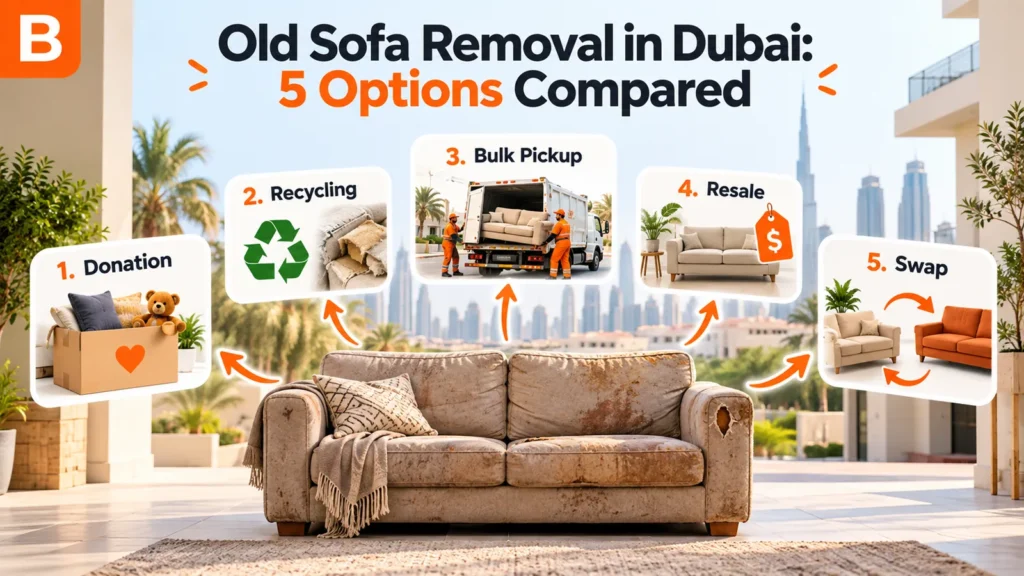
A sofa combines every difficulty at once. It is heavy, it does not fit in a car, it cannot go down a rubbish chute, and it usually has to be gone by a specific date because a handover inspection is coming.
That combination of weight and deadline is why so many perfectly good sofas end up beside a bin room at the end of the month. Not because they were worthless — because the owner ran out of time.
Every option below works. The right one depends on two things: what condition the sofa is in, and how many days you have.
This is the step almost everyone skips, and it is the one that wastes an afternoon.
A sofa that fits beautifully in a room may not leave the building. Before you arrange anything with anyone, measure in this order:
The service lift is where most removals fail. A three-seater standing on its end needs more height than people expect, and buildings often require the service lift to be booked in advance with a time slot.
Then ask the one question that changes everything: do the legs come off? Many sofas lose 10–15cm that way, and it is frequently the difference between fitting and not. Check for bolts underneath before you conclude it is stuck.
If the sofa is structurally sound and honestly describable, swapping keeps its value with you rather than handing it to a truck.
Furniture is one of the most actively exchanged categories in the UAE for a structural reason: people arrive needing to furnish an empty home at roughly the rate others leave needing to empty one. Your departure problem is someone else’s shopping list.
What makes a sofa listing actually work:
That last point prevents most wasted conversations. More in swapping furniture in the UAE.
When speed matters more than return, a free listing with a firm collection window often clears a sofa within a day.
The trick is being explicit. Vague free listings attract plenty of interest and very few actual collections, because nobody has committed to anything. “Free, must be collected by Thursday 6pm, third floor with service lift, first to confirm” works far better than “free to a good home”.
Charities sometimes accept furniture, but condition requirements and limited collection capacity are the norm rather than the exception. Ask before assuming, and be honest about the state of it — an organisation that has to dispose of an unusable donation is worse off than if you had never offered. See where to donate in Dubai.
Worth it for genuinely high-end or designer pieces with real resale demand. Less often worth it otherwise.
Be realistic about the friction: furniture buyers routinely expect delivery included and negotiate hard from the asking price, which is why so many furniture sales quietly become giveaways in the final week. See selling to a used furniture buyer vs swapping.
Removal services will take a sofa away, frequently at no charge, because they resell or recycle what they collect. Fast, requires nothing from you but access, and genuinely useful when you are out of runway.
The trade-off is that you receive nothing back, and everything on the truck is treated the same regardless of condition. Use it for what you could not realistically pass on yourself rather than as the default for the whole flat.
Two things to confirm when booking: whether they carry from inside the apartment or only from the ground floor, and whether your building requires them to be registered for access. More in junk removal vs swapping.
Municipalities operate bulky-waste services for large household items, subject to their current conditions and booking process. For Dubai, check the service details on the Dubai Municipality website; other emirates run equivalent services, and many buildings have their own procedure on top.
Book it in advance. These services run to a schedule, and discovering that on your final day is a genuinely bad position.
This is the right route for a sofa with a broken frame, water damage, mould, pest signs or exposed foam — things that should not be passed to another household at all.
Three sofa types behave differently enough to be worth calling out, because each catches people out in its own way.
Sofa beds are considerably heavier than they look, because of the steel frame and mechanism inside. Two people who could carry a normal three-seater may genuinely struggle. Say plainly in the listing that it is a sofa bed, and test the mechanism opens and closes smoothly before anyone agrees to take it.
Corner and L-shaped units usually separate into two or three pieces, which makes them far easier to move than their footprint suggests. Find the connecting brackets underneath before deciding it is immovable, and photograph the sections apart so the other person can see what is actually involved.
Modular sofas are the easiest of all to move and the easiest to list badly. Count the pieces, say how many there are, and mention whether all the connectors are present. A modular missing its clips is a pile of cushions rather than a sofa, and that needs disclosing.
Do not leave a sofa in a corridor, stairwell, car park, service area or beside the communal bins.
It blocks access, creates a fire and safety problem, usually breaches building rules, and can affect your handover inspection or deposit. It also tends to be weather-damaged within a day, so even a well-meant “someone will want this” ends in landfill.
If you want someone to have it, list it properly. That takes five minutes and actually works. On the deposit risk specifically, see will leftover furniture cost your security deposit?
Working backwards from the date it must be gone:
The fallback identified on day 5 is what turns a cancellation into an inconvenience rather than a crisis.
Two free routes: list it to swap or give away with a firm collection window, or book a removal service that takes furniture at no charge because it resells or recycles. The first returns something to you; the second does not.
Yes. Collection services take sofas routinely, often at no cost. Confirm whether they carry from inside the apartment and whether your building requires them to register for access.
No. It can breach building rules, block access and create a safety problem, and it may affect your handover. Use an authorised bulky-waste service or a collection provider instead.
If it is structurally sound and honestly describable, yes. Furniture moves well in the UAE because arrivals and departures overlap continuously. Measure the route first and state a firm collection date.
Check whether the legs unbolt — that often gains 10–15cm. Then try it diagonally and on its end. If it genuinely will not leave, a collection service with the right equipment is the realistic answer.
A week for a sofa. It needs someone who wants it, transport, building access and usually two people — none of which can be arranged in an afternoon.
If your sofa still has life in it, do not send it to landfill. List it on Bartr with dimensions and a collection date, and see what it could become instead.